Los grandes amores de muchos colores, me gustan a mí

Excerpts from a delegation blog by Elisabeth Grunert from Christ Episcopal Church, linked with San Andrés Itzapa Episcopal Community in Guatemala.  Writing a daily or periodic blog during a delegation can be a great way to share the experience with family, friends and other members of your church.

WholeChurchPlease excuse the silence! I am returning from a period of recovering and reflecting following a one-week trip to Guatemala. From January 10-17, a delegation from my church paid a long overdue visit to our church’s sister parish.

To clarify, this is not a mission trip. We were there because of our church’s participation in the Sister Parish Program. We were not there to evangelize, as the people we were visiting are Christians, who use the Book of Common Prayer, just as we do. We were not there to lead a program, or build a school. We were there to renew our relationship, be encouraged and transformed by the fellowship with Guatemalan Christians, and, in the words of our committee chair, “to accept the hospitality of our hosts.” Accepting the hospitality of someone who lives in a developing country and does not speak your language requires humility. Accepting hospitality creates transformation in itself…

Read more.

——————–

Thursday was a peak, in more way than one. For one thing, we traveled to a part of Guatemala that, at about 7,000 feet above sea level, was higher than either Ciudad Guatemala or San Andres Itzapa.  For another, the day was one of majestic beauty and awe that seemed to unfold further all day.
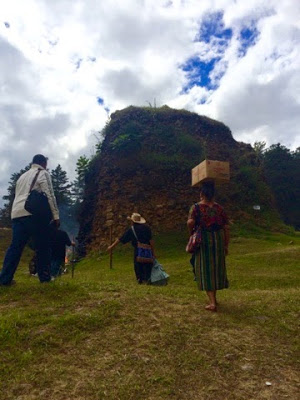
Walk at GuarmarcaajWe left Ruth and Naomi bright and early and rode in our trusty tour bus to the ruins at Guarmaarcaaj, not too far from Chichicastenango. What first struck me when we got off the bus was the strange mixture of spring-like, refreshing weather, and the copious Spanish Moss on the trees. I don’t usually associate Spanish Moss with April-like weather, but the combination was delightful…

I have no pictures of the actual Mayan ceremony that we did at the ruins. It was far, far too holy. I mean, I don’t usually take pictures of church, either. Don Otto communed with the ancestors and felt their approval of the spot he chose. …We acknowledged the ruling ancestor of the day: the eagle. Which, Don Otto noted, was a symbol for the United States, so he felt the ancestors’ especial welcome of his American guests. We offered strings to the fire for relationships, multi-colored candles to honor the diversity of nature, etc. We offered to the fire things for which we wished to be forgiven, and we again remembered (and greeted) our dead by giving their names to the fire. I remember him talking about the dead, specifically (at that moment), those that had been killed in the violence of a few decades past, and proclaiming that they are more powerful now than they were when they were alive, that they are in the air, in the water, that their blood is in the earth. I remember feeling very, very, watched. In a good way.  We were also told, with conviction, that the ancestors would watch over our return home. We would arrive safely. I hadn’t realized I was nervous about it until I sighed with relief, then.

GrillAfter the ceremony, we were both tired and very, very calm. And when the women handed us grill-cooked corn on the cob, we realized we were powerfully hungry!

——————–

…If Thursday was a spiritual high, Friday was an emotional one.

We had one more morning with our host families on Friday, and then all gathered again in Basilia and Otto’s courtyard…What a blessing the children were to us! We usually think of adults as the ones to offer services to children, and of children as being in need of our help. But this week reminded us of how much adults need children. We need their beauty, their joy in learning, their joy in teaching, their sense of fun and humor even at serious times, and their laughter! I am so grateful for the children of San Andres Itzapa. This Sunday when I teach Children’s Chapel at church, I’m going to be telling the kids about the brothers and sisters they have in Guatemala and trying to establish a pen-pal relationship. This sister church relationship will depend on children in many ways. In the morning, the youngest girl, Keli, asked me to braid her hair, the way she’d seen me braid mine all week. She had a lot of gorgeous hair, so it took me a while. She wore it to school. From a 13 year old, that’s a compliment.  I felt so proud!
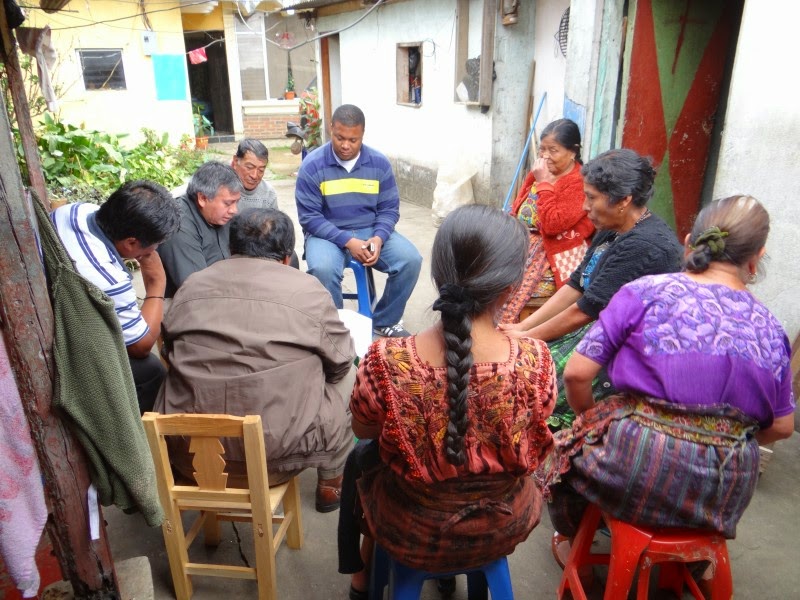
CirclingUp…Later in the morning, Julieta led us in a couple of team building exercises. The leadership from Sister Parish is determined that this relationship be maintained! For one of the exercises, we played a circle game in which we threw and caught four balls in a pattern around the circle. There was much laughter even as we concentrated on the exercise. Afterwards, we had to write down the values or skills that we needed to succeed in the game. Then, Julieta let us know that these were also the values we’d need to succeed in our Sister Parish Relationship.  You’ll see skills like: focus, awareness of partner, laughing together, practice, vision, help, love, dynamism, willingness to learn, agility, recovery from errors, and more. It’s a great list…

After a lovely lunch, we walked down to church. I remember the walk clearly. It was a long downhill to church….The mass we had that morning will go down as one of the most memorable services of my life.
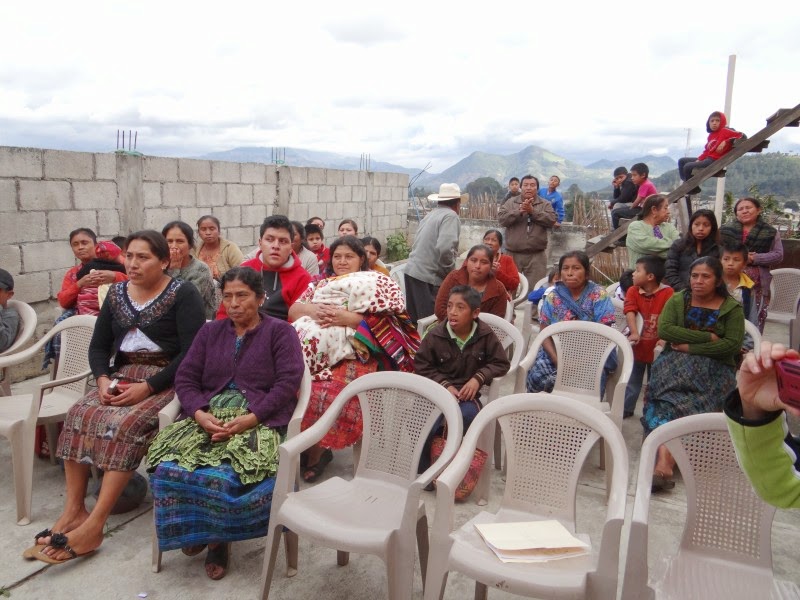
churchThis is church, guys. There were men, women, children, babies through teenagers. We used the Libro de Oracion Comun (Book of Common Prayer) and so, despite our varying levels of Spanish ability, we were all able to participate and know precisely what we were saying. There were some cool differences, though.  Instead of “Therefore, let us keep the feast,” they say, “Celebramos la fiesta!” Different connotation, eh? We loved saying that.

The prayers and hymns were in Spanish, but Padre Miguel asked that we do the scripture readings in English. I got to read the gospel! If you belong to a liturgical church, you know what an honor this is. The gospel reading was the calling of Nathaniel. “I tell you the truth: you will see greater things than this.” On point.

We also sang (amateur choir though we are) some songs for the service. Ready? We sang “Seek Ye First The Kingdom of God,” “De Colores,” “Amazing Grace,” and a very energetic “This Little Light of Mine.” It was a blast.
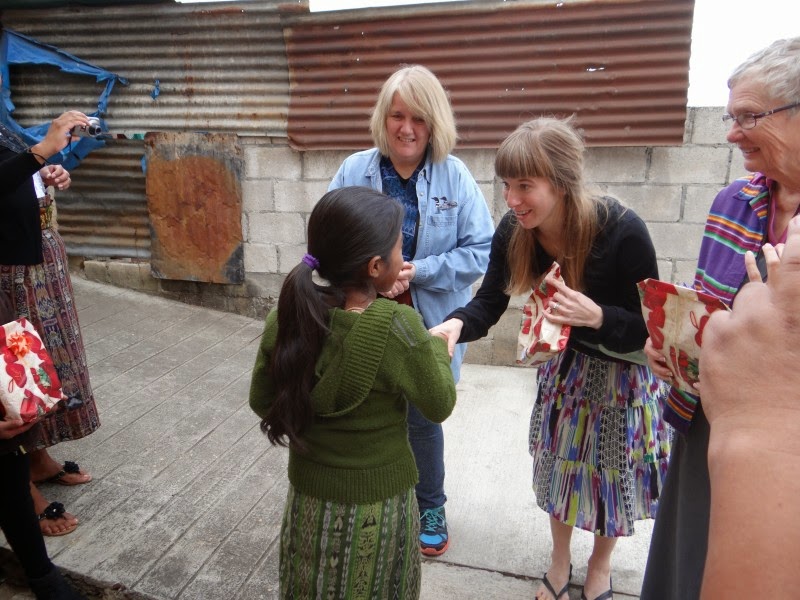
Me&ChildAfter the service, and I didn’t think I could be more emotionally charged… there were speeches and presentations. Goodbye speeches, gifts, (to add to the lovely ceramic angel and tortilla basket and cloth we’d received already) and, to my joy, the children had a special goodbye to say…

We were so happy, and so distraught to be leaving, both at once. I wished for the whole congregation of my home church to be here to see our brothers and sisters, and to know the transformation that this relationship has brought our delegation. We have a few opportunities coming up on February 22nd, and at another event after Easter, to try to convey our experiences and our hopes for the program as we move forward. Keep us in your thoughts, please! We want to be good ambassadors.

——————–

GoodbyeWe want so much to rejuvenate this program, to make the congregation know what a treasure this relationship can be. We have high hopes of bringing a delegation from Guatemala up to the states as soon as we can muster the funds.

And up there, [in Guarmaarcaaj and San Andrés Itzapa], at what felt like the top of the world, all things felt possible.



Posted in Delegations, General, Guatemala, North to South | Tagged , , , | Leave a comment

Finding Our Shared Humanity

A reflection by a former delegate from First Lutheran Church of Duluth, partnered with San Antonio Los Ranchos in El Salvador.

Memorial WallDuring my senior year of high school, I went on my second trip to visit our sister congregation in Los Ranchos, El Salvador. This trip, like the first one, was much different than what I expected of a so-called “mission trip”. When one thinks of a mission trip, most envision building a home and following the general format of a Habitat for Humanity volunteer experience. While those endeavors are necessary and beneficial, the Los Ranchos trip is unique in its approach, making it all the more valuable and important.

While in Los Ranchos, we each stayed with a host family, often in only one or sometimes two room homes where the whole family slept together. Instead of going there to “do” something, we went there first and foremost to learn: to exchange ideas, cultures, and dreams. Rather than simply implementing a project, this process of exchange enabled us to find our shared humanity. Even though I stayed with people with whom, by my initial impression, I had nothing in common, we ended up finding that we were all more similar than we thought. Like me, other kids my age wanted to go to college or find jobs that would enable them to support themselves and perhaps start a family. However, unlike me, they encountered much higher barriers to these things that many Americans take for granted. Every family had a relative directly affected by the drawn out civil war during the 1980s and into the 1990s. Every family had a family member who was in the U.S…., working just so that they could support their families back in Los Ranchos. Most had left not wanting to work illegally in the U.S., but had felt they had no other option. Kids my age remaining in the community wanted to go to college, but most lacked the financial means to do so. From all of this, we learned that many of the biggest problems the community faced were economic barriers to education and resulting barriers to employment. Rather than going in to fix something in the community without proper knowledge of the key problems beforehand, we were able to find out directly from the community what they needed most. As a result, First Lutheran established a scholarship fund to support bright college students from Los Ranchos who are committed to staying in El Salvador and investing in making the future of Los Ranchos more vibrant.

I most recently worked on an international development project implemented in Southern Syria. Our project assesses and repairs essential infrastructure in war torn communities. Damaged infrastructure includes damaged municipal water supply, shelled schools and hospitals, and destroyed electrical infrastructure. Before even designing or implementing a project, our Syrian engineers go to a community to speak with the community members in order to get an accurate view of the community’s most needed projects. The Los Ranchos trip first opened my eyes to the importance of directly engaging with people, finding our shared humanity, and then working to improve each other’s lives from there. While I like to think that we were able to make an impact on people’s lives in Los Ranchos, what I know for sure is that my experience with them deeply affected my life, enriched it, and set me on the path where I am now.

– Leah R., April 22, 2015

Posted in Delegations, El Salvador, General, North to South | Tagged , , , , | Leave a comment

Radical Hospitality

A reflection by a former delegate from First Lutheran Church of Duluth, partnerned with San Antonio Los Ranchos in El Salvador.

Painting.emfI did want to write a short message reflecting upon how the delegation trip in 2010 has left an impact upon my life.  I’ve shared this with many people, including members of my present congregation, but in a big way, the Sister Parish El Salvador trip was one of the deciding factors for my enrollment in seminary to pursue ordained ministry.  As we learned about Archbishop Oscar Romero and how God took this relatively soft-spoken, bookish priest—hardly one to rock any boats—and led him to encounter the risen Jesus Christ among the Salvadoran people who were experiencing such hardships, so much that his heart was changed and his heart became one with the heart of the people, I found that if God could take this imperfect man and change the world through him, God could certainly work through me.  I enrolled in an online seminary program several months after returning and have often spoken of this delegation trip while discussing with others my call to ordained ministry.

The other big way that it left an impact on me was the experience the hospitality of our host family.  Reagan and I stayed with the Serrano family (Miguel Serrano had received a scholarship) and I will forever remember how honored I felt as their guest—honored in ways that I knew they were making a sacrifice on their part to host me—and that they were glad to do that.  Their actions taught me about the sacrificial nature of radical hospitality—the kind that Christ has shown us in the cross—making room for us at a real cost.  And, yet, despite the cost, joy can be found there.  The Serrano family were powerful preachers to me and I thank God for them and for all of your efforts in making that delegation trip possible and maintaining the Sister Parish relationship between First Lutheran and Los Ranchos!  It has been a joy to be a part of…

– B.D., April 24, 2015

Posted in Delegations, El Salvador, General, North to South | Tagged , , , , , | Leave a comment

Comunicado por el Día Internacional de la Mujer

IMG_7021

El grupo de mujeres de Tierra Nueva II que participa en la Mesa Multisectorial.

In English

Comunicado de la Mesa Multisectorial por la Cultura de Paz y la Maternidad y Paternidad Responsable en el “Día Internacional de la Mujer”

Al reflexionar sobre las condiciones de vida de las niñas, adolescentes y mujeres de nuestras comunidades, deseamos manifestar nuestra profunda preocupación por algunas situaciones sociales que vulneran y ponen en riesgo nuestras vidas y derechos humanos.

La problemática de nosotras las mujeres es realmente alarmante cada vez, se acepta que la fuerza es el recurso último o habitual cuando está interiorizado como parte de la cultura propia y de nuestra forma de hacer para obtener la razón, se continúa construyendo una sociedad violenta y en permanente amenaza.

El Maltrato hacia la niñez. Aunque existe leyes y las personas están empezando a aceptar su responsabilidad para denunciar el maltrato físico, psicológico, sexual, aún existen muchos casos que permanecen como un secreto que todos conocen pero nadie se atreve a hablar.

IMG_7018

Albertina lee el comunicado durante la misa en Tierra Nueva II el 8 de marzo.

Madres adolescentes. En Tierra Nueva cada día nos enteramos de jovencitas embarazadas, la indiferencia o naturalización del hecho, e indiferencia de las familias e instituciones gubernamentales y no gubernamentales. Las acciones se han reducido a aceptar la situación, pretendiendo que ellas naturalmente deberán madurar y aprender a asumir la responsabilidad. Otras veces obligadas también a asumir responsabilidad como esposas y amas de casa. Sus oportunidades de desarrollo integral y derechos a la salud y educación queda en el olvido. Los adolescentes madres y padres, necesitan el apoyo integral y el acompañamiento familiar para garantizar el bienestar de sus familias. Apoyamos la propuesta de Ley del observatorio de Salud Reproductiva de prohibir que los adolescentes se casen, ya que el matrimonio debe ser una decisión consciente y madura cuyo principal objetivo sea generar el bienestar familiar y no una obligación para enmendar errores.

Las mujeres adultas, continúan enfrentando situaciones de violencia en todas sus manifestaciones, dentro del hogar, en las comunidades y en la sociedad.

La impunidad ante los crímenes, violaciones a los derechos humanos y la lentitud de los procesos legales de las autoridades justicia son una burla ante las bien intencionadas leyes a favor de las mujeres.

La igualdad y equidad de derechos entre hombres y mujeres, sigue siendo un reto y hace falta accionar a través de las organizaciones civiles para empoderamiento comunitario.

En lo laboral, enfrentamos la discriminación y rechazo a mujeres mayores, madres solteras. La aceptación de mujeres jóvenes también está condicionada a ciertas normas que violentan sus hábitos personales, maquillaje exagerado, vestuario ajustado o escotado o no adecuado al clima, son situaciones que deben aceptar muchas mujeres. Otra situación es, los horarios de trabajo y los salarios. La violación a sus derechos a la salud, especialmente durante el embarazo o el condicionamiento que no deben embarazarse. Existe también el rechazo o discriminación debidos a su condición física que las obliga a mantenerse delgadas y jóvenes. Promoviendo cultura machista y sexista, usándolas como gancho de atracción comercial.

En cuanto a la niñez trabajadora. Continuamos viendo en las esquinas a niñas vendedoras ambulantes en las calles, o victimas del comercio sexual, bajo la indiferencia del Estado garante de los derechos y protección.

Las mujeres adultas mayores.

Avanzan los años en la vida de las mujeres,   que han dedicado su vida a sus hijos esposo y también nietos, en muchos casos de nuestras comunidades después que crecen los hijos, fallece el esposo estas mujeres se encuentran solas, y no solo esto, con ello el incremento de la discriminación y marginación social. Falta de vivienda, abandono o desvalorización familiar. La pobreza extrema que les obliga a someterse a trabajos forzados sin remuneración o a cuidar y servir como empleada doméstica.

Otro ejemplo de inequidad, son las mujeres que por sufrir una discapacidad mental o física, es violentada en sus derechos a la salud, a la familia. Tenemos el caso de la mujer que actualmente vive en la calle, atrás del polideportivo, aquí en nuestra comunidad Enfrentando una vida de desvalorización, marginación, abandono. El gobierno no hace su labor de protección y vigilante de los derechos humanos especiales de estas personas.

  • Es tiempo de empoderarse, de cambiar. De levantarse y alzar la voz.
  • Las mujeres somos fuertes en voluntad, en actos, en sentimientos, en razón.
  • No fuertes como una roca, sino como la leona, cuidando y amamantando a sus cachorros.
  • La mujeres somos seres humanos capaces de pensar con el corazón, actuar con la razón y vencer por el amor.
  • Las mujeres somos y seguiremos empeñadas en luchar porque nos reconozcan como seres humanos en igualdad de derechos.
  • Las mujeres seguiremos luchando por contribuir a esta sociedad fomentando la equidad y los valores humanos fundamentales.
  • Las mujeres somos seres dignos e importantes en nuestra sociedad y ante cualquier labor que deseemos desempeñar.

NO A LA VIOLENCIA, LA DISCRIMINACIÓN, LA IMPUNIDAD.
SI A LA VIDA CON RESPETO Y DIGNIDAD

IMG_6165

La marcha del Día Internacional de la Mujer realizada el 8 de marzo de 2015 en Guatemala.


Posted in Español, General, Guatemala | Tagged , , , | 1 Comment

Women’s Group Releases Statement on International Women’s Day

IMG_7021

Members of the Women’s Group in Tierra Nueva II on International Women’s Day

En español

Statement released by the Mesa Multisectorial por la Cultura de Paz y la Maternidad y Paternidad Responsable, a community-based coalition in Chinautla

Reflecting on the lives of girls, adolescents and women in our community, we wish to express our deep concern about certain situations that undermine our human rights and pose a threat to our lives.

Our predicament as women is increasingly alarming. Force is accepted as a last resort or sometimes as habit when the acceptance of violence is internalized as part of the culture and therefore of the way we justify our actions. This contributes to a violent society in which we face ongoing threats.

Child abuse. Although child protection laws exist and people are beginning to accept their responsibility to report physical, psychological, and sexual abuse, there are still many cases that remain unreported because everyone knows about the abuse but nobody dares to speak out.

Teenage mothers. In Tierra Nueva every day we hear about pregnant girls. We also see that families, government institutions, and NGOs are often indifferent toward teenage pregnancies or they accept teenage pregnancies as normal. Not many actions are taken, with the argument that we need to accept the situation and the young women need to mature and learn to assume responsibility. The young women are sometimes also forced to take responsibility as wives and housewives. Their holistic development and their rights to health and education are ignored. Adolescent mothers and fathers need comprehensive support in order to ensure the well-being of their families. We support the proposed Law in Observance of Reproductive Health, which includes a ban on child marriages. Marriage should be a conscious and mature decision made in the interest of family well-being and not an obligation to correct errors.

Adult women continue to face violence in all its manifestations, within the home, in communities, and in our wider society. Impunity, human rights violations, and the authorities’ slow legal process only mock the well-intentioned laws passed in favor of women.  Achieving equity and gender equality remains a challenge, and we need community organizations working for empowerment to take further action.

IMG_7018

Albertina reads this statement at mass in Tierra Nueva II on March 8.

The workplace.  We face discrimination and it is difficult to find a job, for older women and single mothers in particular. When young women are hired, they often face compromising conditions, including requirements like wearing heavy makeup or tight, low-cut uniforms that are not appropriate for the weather. Many women must accept these conditions. Working hours and wages are also problematic. Conditions often violate women’s right to health, especially during pregnancy; or women are given work only for as long as they don’t get pregnant. Not getting hired or facing discrimination due to their physical condition forces many women to stay thin and young-looking in places that promote chauvinistic and sexist practices and use women as bait for attracting customers.

Child labor. We continue to see young girls on the street as vendors or as victims of the sex trade. The state remains indifferent, even though it should protect people and their rights.

Elderly women. The years pass quickly for women who have dedicated their lives to their husband, children, and grandchildren. In many cases, after their children have grown up, when their husband dies, women are left alone. Elderly women face discrimination, marginalization, homelessness and neglect, and they are sometimes treated as less valuable in their homes. Extreme poverty forces them to submit to forced labor without pay or to work as domestic servants.

Women that suffer from a mental or physical disability also face inequality. Their rights to health and a family are often violated. There are women currently living on the street behind the sports hall in our community. They live with devaluation, marginalization, and neglect. The government fails to comply with its obligations to protect and safeguard the human rights of these women.

  • It’s time to empower ourselves, to change, to stand up and speak out.
  • Women are strong in will, actions, feelings, and reason.
  • Not strong like a rock, but strong like the lioness, caring and nursing their pups.
  • Women are human beings able to think with the heart, act with reason and overcome with love.
  • As women, we are and will be bent on fighting until we are recognized as human beings with equal rights.
  • As women, we will continue to fight to contribute to this society by promoting fairness and fundamental human values.
  • Women are worthy and important in our society and we can do any job we want to do.

NO TO VIOLENCE, DISCRIMINATION, IMPUNITY.
YES TO LIFE WITH RESPECT AND DIGNITY.

IMG_6165

International Women’s Day March in Guatemala City.

Posted in General, Guatemala | Tagged , , , | 1 Comment

Reflection on Monsignor Oscar Romero

anniversary_delegation_9

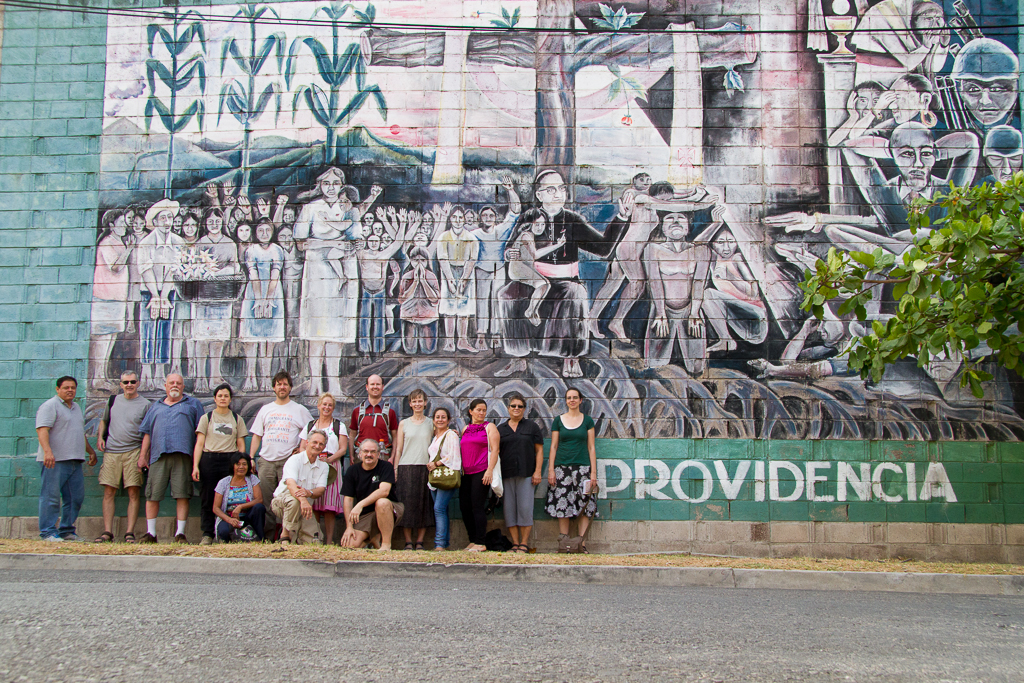
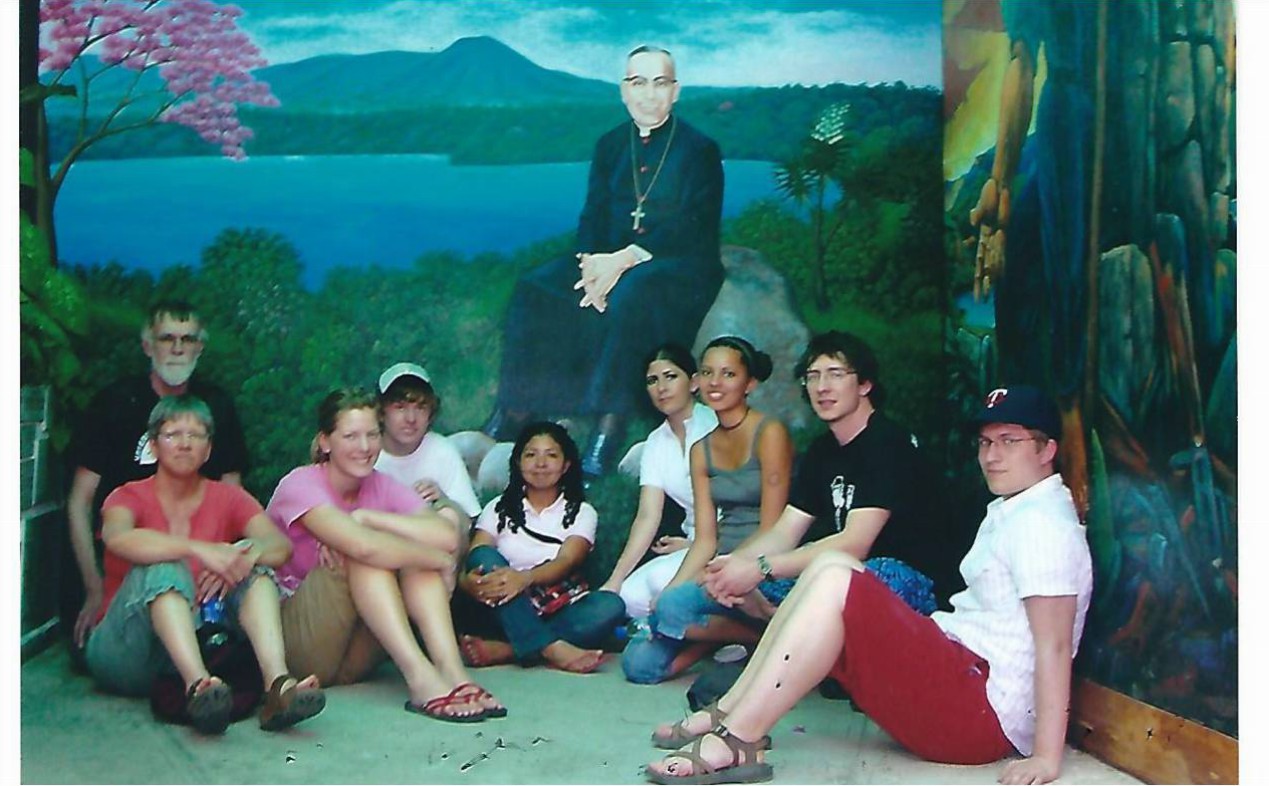
Sister Parish Delegation in front of the mural at Divina Providencia.

En español

By Marta de Monge (Sister Parish committee member)

Potrerillos Community, Nombre de Jesus, Chalatenango, El Salvador

Oscar Arnulfo Romero Galdamez was born in Ciudad Barrios in San Miguel on August 15 of 1917. He came from a modest family like our Lord Jesus. He was baptized on May 11, 1919 in the church of Ciudad Barrios. His father, Santos, was a telegraph operator and his mom was a housewife.

During his childhood, his father taught him to enjoy reading and reflecting in silence. He loved to help his father distribute the mail and telegrams around town. From his mother, he learned devotion to the Virgin Mary and the Saints. He was fed with piety, prayers and compassion. We know that Oscar Romero was a very reserved and shy boy. He was a very good student, not very good at math, but really good at social sciences and music. Oscar had to leave school at the age of 12 because he was very sick. Later, he worked as a carpenter.

Once, he was invited to a priest’s ordination. That is when Oscar felt the call to become a priest and he decided to go and live at the seminary in San Miguel in 1931 at the age of 12. He lived there for 6 years. There were times when he had to interrupt his studies at the seminary in order to work to support his family through economic difficulties. Time after time, he returned to the seminary until he was ordained as a priest.

Throughout his life, Romero got to know and love God with all his heart and soul; that is the Monsignor Romero we know. In April 1941 he wrote: “I have taken state into the sacred heart of Jesus; today Lord, I just ask you one thing, faithfulness”.

When we see Monsignor Romero’s life, we can understand and see how the life and teaching of Jesus was brought to life once again in Romero. There is no doubt. We see a lot of similarities between Romero and Jesus. Romero, for instance, decided to become a priest at the age of 12. He also worked as a carpenter and carried out a three-year ministry, similar to Jesus’ three years of preaching.

Oscar Arnulfo Romero’s public life was like seeing Jesus walk through El Salvador. Jesus walked through Jerusalem and the people did not recognize him as the Messiah; Romero walked through El Salvador and his people did not recognize him as the prophet. They crucified Jesus and they did not recognize him as the Messiah. The story is repeated with Monsignor Romero; he was also martyred and still many people did not recognize Christ in him.

Romero was a man of God and our friend, an example to follow. As Christians we are called to denounce, to speak out against injustice, and to fight the indifference shown to the suffering and the poor. We feel proud to have this Saint from El Salvador. We need to understand that we are all called to be Saints by following Jesus Christ.

Since his birth Oscar Romero was the new Christ, not just for El Salvador but for all people around the world. Jesus was Christ not just for the people of Israel or Jerusalem but also for all people around the world; he is Christ even for those who are not Christians.

Romero saw no difference between rich and poor. He suffered with those who were suffering and he shared joy with those who had joy.

For me, all of this means he is a Saint and an inspiration in my life. I am very happy that we have a Saint from our country. Like Jesus, Monsignor Romero was a man for humanity. Romero, like Jesus, gave his life for his love of humanity, his love of justice, and his efforts to build the new kingdom of God here on earth with peace and love.

Posted in El Salvador, General | Tagged , | 2 Comments

The Promise of God had Become a Reality: The Beatification of Monsignor Romero

En español

By Julieta Borja
Sister Parish El Salvador Regional Coordinator

I feel extremely happy after hearing about the beatification of Monsignor Romero. For all of us in El Salvador, as for many people around the world, he has been a martyr and a Saint from the day he was murdered.

IMG_9971

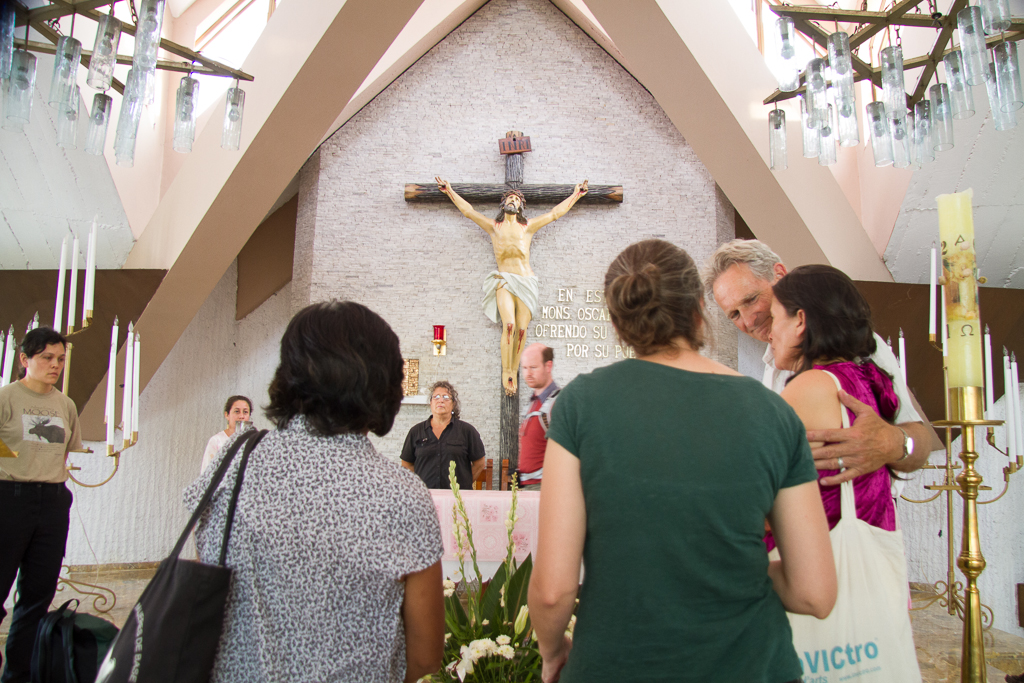
Delegation visits the chapel at Divina Providencia, where Romero served and was murdered.

It took 35 years for the Catholic Church to recognize him as a Saint of the Church.  But the people of God had recognized him as a man of God, as a pastor, as a prophet, as a Saint in his worldly life as he walked at the side of the poor in El Salvador. His people declared him a martyr right after his murder.

The people of God (the people of El Salvador) came to know him in the breaking of the bread, in walking with the poor, when he spoke out for us, and when he denounced the injustices of those times.

Romero’s saintliness was not revealed first to the hierarchy of the church but to the people of God. How true it was, how true it still is, that “these things are only revealed to the poor and humble of God.”

Oscar Arnulfo Romero came to carry out the will of God, to free the captives, to relieve the oppressed, and to announce that the kingdom of God is near. With him, as with Jesus Christ, this passage from Isaiah becomes a reality:

Isaiah 42:1
“Here is my servant, whom I uphold, my chosen one in whom I delight; I will put my Spirit on him, and he will bring justice to the nations.”

Isaiah 49:9
“[I will…make you to be a covenant to the people] to say to the captives, ‘Come out,’ and to those in darkness, ‘Be free!’  They will feed beside the roads and find pasture on every barren hill.”

Surely the spirit of God flowed onto and into Oscar Romero and accompanied him during the 3 years of his ministry. He can say, together with Jesus Christ:

“The Spirit of the Lord is on me, because he has anointed me to proclaim good news to the poor. He has sent me to proclaim freedom for the prisoners and recovery of sight for the blind, to set the oppressed free (Luke: 4:18).

Today we celebrate his life, but more than that we celebrate the resurrection of the church. We celebrate today the birth of an opportunity for building real justice.

We celebrate and we hope that the cries of the many families who call for justice can be heard and that the beatification of Oscar Arnulfo Romero Galdamez becomes the door to the construction of true peace.

I want to share a dream and invite others to dream with me. My dream is this: that Romero’s beatification will open a door to attaining real justice, because only then will we reach peace in this little but giant nation, El Salvador.

Posted in El Salvador, General | Tagged , | 2 Comments

Guatemala Representatives Meet to Learn, Reflect, and Plan

IMG_6104In February, representatives from the eight Sister Parish communities in Guatemala gathered for a weekend of fellowship, learning, and spiritual reflection.  We are posting the meeting report, photos, and a song video we made for the Northern churches (below), in the hopes that you can share in this weekend with us.

Throughout the weekend, the group had powerful reflections on historical memory, our own diverse life experiences, and current struggles.  Among other activities, we visited the House of Memory Guatemalan history museum.  The museum was created to reconstruct a part of history not often taught in schools, the history of the Maya before the Spanish conquest, the history of the system of oppression established under the Spanish that, in many ways, remains in place, and the history of resistance and resilience during the internal armed conflict. At the door, the museum opens with a poem from Guatemalan poet Humberto Ak’Abal:

IMG_6119‘Now and then
I walk backwards.
It is my way of remembering.

If I only walked forward,
I could tell you
about forgetting.’

After walking through the museum and talking about the experience, the Guatemla Directiva chose to reflect on a passage from Mark 1:12-15.

12 At once the Spirit sent him out into the wilderness, 13 and he was in the wilderness forty days, being tempted by Satan. He was with the wild animals, and angels attended him.

Jesus Announces the Good News

14 After John was put in prison, Jesus went into Galilee, proclaiming the good news of God. 15 “The time has come,” he said. “The kingdom of God has come near. Repent and believe the good news!”

IMG_6125Representatives saw many ways in which this passage relates to their lives and shared the following reactions:

– God is love

– There have been many catechists and priests killed for bringing the Gospel, just like they killed Jesus. They tortured John to silence him, but he can’t be silenced.

– They tortured Jesus and they are still torturing people. They say we are terrorists. How many children were killed, how many massacres were carried out in communities during the war here? According to the Mayan worldview (cosmovisión), with Oxlajuj Baktun (21 December 2012 in the Mayan calendar), we will see a change. God wanted us to fight injustice; God wants us to fight injustice. God is love and this is love, us here together. We have the candles lit and that light is our direct line to God, our communication with God.

– We all have dignity. We were created in God’s image. We don’t have the same shape as God, but we all have that dignity. Maybe some people are drunks or thieves, but each of us is the child of God.  We should not make our wealth (or have treasures) here on Earth, but in Heaven. So many people suffer and sacrifice to buy eggs, an Aspirin, while others have great wealth and possessions. Jesus Christ was the first subversive to fight injustice. He couldn’t be bought off with money. We have to hold Jesus as our guide and leader.

IMG_6147– God repented, after the flood and the destruction it wrought. God gave a warning, but people didn’t accept it… There is temptation, but Jesus went to the synagogue and he opened the book and he read the prophecy. The Spirit was upon him and he announced his projects to seek freedom for the oppressed. This is a political project. Lifting up and healing the sick is a health project. Public policy at that time did not favor the people; it was an exclusive system. Because it was Saturday, people were there and Jesus brought the good news, the Gospel. He spoke of the prisoners – they could have been political prisoners, just like many people here are behind bars for defending their people. There are arrest warrants for people in San Juan Sacatepéquez, La Puya, and Huehuetenango. They committed no crime, but they have been persecuted. Others have gone into exile. Jesus wanted to free the oppressed. Our community’s history is not over and each of us can decide what we do. This is voluntary; there is no obligation. Those of us Christians who want to can take up the cross. “Follow me,” Jesus said.   Each of us thinks about how we will do this in our lives. Archbishop Gerardi, who first worked in Quiché, a department of Guatemala with a long history of oppression, is one example of a defender who was persecuted. For me, our struggle to defend our collective rights, our rights as indigenous peoples, is born out of our Christian values.

Truly these reflections show a deep reckoning with this message of  the apostle Mark.  What does this passage mean to the rest of us?  How are we called to do God’s work in our own lives?

Posted in Guatemala | Tagged , | Leave a comment

Entrevista con Narcisa Escobar – Reflexión sobre la delegación

In English

IMG_5030

En agosto de 2014, 10 personas de Sta. Juana de Arco llegaron para visitar su hermanamiento en Tierra Nueva 2.  Narcisa nos cuenta cómo fue la experiencia para ella como miembro del comité y participante en la delegación.


¿Qué significan las delegaciones para usted y su comunidad?

Iglesias Hermanas y las iglesias del norte son muy importantes para nosotros. Nos vienen a motivar para seguir adelante en nuestras vidas, y con el trabajo en la iglesia.

¿Cuáles fueron las actividades más impactantes durante la delegación?

Me impactó la ida a Cobán. Aquí en Guatemala, no nos damos cuenta de los problemas que vive la gente en nuestro proprio país. Me impactó que están sacando a las familias [en los deslojos] y las familias no tienen dónde. Son pobres. Vimos como la gente está luchando para un pedazo de tierra para poder sobrevivir.

IMG_0541También me gustó compartir con los hermanos. Fuimos a ver el café [de una cooperativa]. Ha sido de alegría andar con ellos. Me di cuenta hasta dónde llega la misión de ellos cuando vienen acá. No vienen a pasear. Vienen a trabajar, a ayudar a uno. Nos vienen a animar, a motivar. Estamos aquí trabajando y nos vienen a animar.

Me sentí feliz cuando estuvimos alegres en la parroquia Nuestra Señora de Guadalupe [en la celebración del 20 aniversario del hermanamiento] – la cena, la piñata, el pastel, para mí fue una alegría. Cuando nos despedimos en fue triste, pero aguanté. No quise llorar. Siento que son mi familia los hermanos, los quiero mucho.

¿Cuáles son sus esperanzas para su hermanamiento?

Que sigan ayudando a los niños, los más necesitados en la parroquia en Tierra Nueva 2. Hay muchas necesidades en la parroquia. A veces los niños son abandonados por sus papás y la ayuda es de mucha importancia. Dios les va a bendecir cada día más por este amor que dan a los niños más necesitados.

¿Otros comentarios que quisiera compartir?

Que estos lazos de amor que nunca se vayan a terminar, que siempre estemos tomados de la manos. Que ellos sigan animándonos, mostrando el amor y cariño que ellos tienen para la humanidad. Ellos están haciendo lo que hizo Jesús, ayudando a los más necesitados.

Posted in Delegaciones, Español, General, Guatemala, norte al sur | Tagged , , , | 1 Comment

Interview with Narcisa Escobar – Reflections on the delegation

En español

IMG_5030
This is a reflection on the delegation from St. Joan of Arc that visited Tierra Nueva 2 in August 2014. As a member of the committee in Tierra Nueva 2,
Narci helped organize many activities and also traveled with the delegates when they visited other areas of Guatemala.


What do delegations mean to you and your community?

Sister Parish churches in the north are very important for us, and delegations too. The delegates come here and motivate and encourage us to keep moving forward, to keep going with our work in the church.

What were the most powerful moments of the delegation?

I was very impacted by our trip to Cobán with the delegation. Here in Guatemala, we don’t realize the difficulties that people in our own country are facing.   It affected me to hear about the evictions of families that have nowhere else to live. They are poor. We saw how people are struggling for a small piece of land, in order to survive.

I enjoyed spending time with our brothers and sisters from the North. We also went to a coffee cooperative. I was so happy to go with them.

IMG_0541I also realized how far their mission reaches when they come here. They don’t come to travel as tourists. They come to work, to help us. They encourage us and motivate us. We are here working hard and they come and inspire us.

I felt happy when we were all together in Our Lady of Guadalupe Church [to celebrate the 20th anniversary of our sistering relationship].  We had  dinner, a piñata, and cake. That was a true joy for me. When we said good-bye, I was very sad, but I held it in. I didn’t want to cry. I feel like they are my family. I love them a lot.

What are your hopes for your sistering relationship?

I hope St. Joan of Arc will continue to support the children in our parish, the ones most in-need. There are so many needs in our church. Sometimes the children are abandoned by their parents and the support is very important. I hope this doesn’t end, but continues. God will bless them every day for the love they show to the children most in-need.

Do you have any other comments you would like to share?

I hope that our bonds of love never break. I hope we will always walk hand in hand. I hope they will continue to inspire us by showing us the love and care that they have for humanity. They are doing the same work that Jesus did.

Posted in Delegations, Guatemala, North to South | Tagged , , | 1 Comment