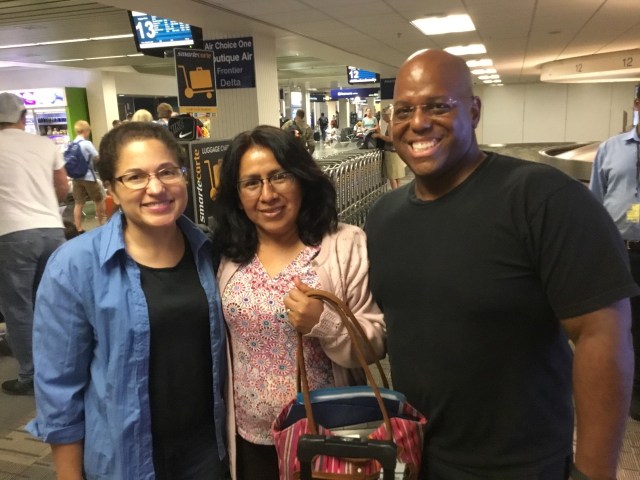
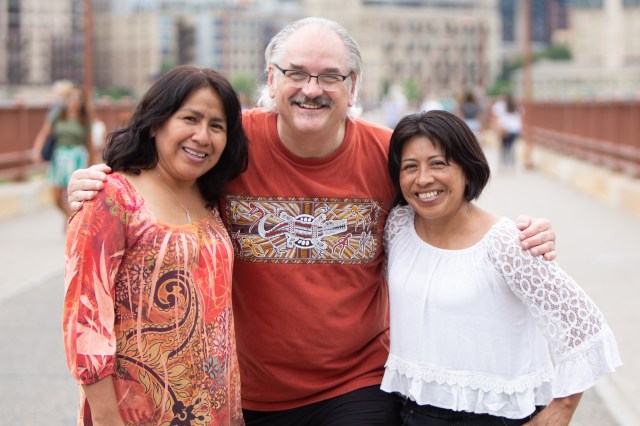
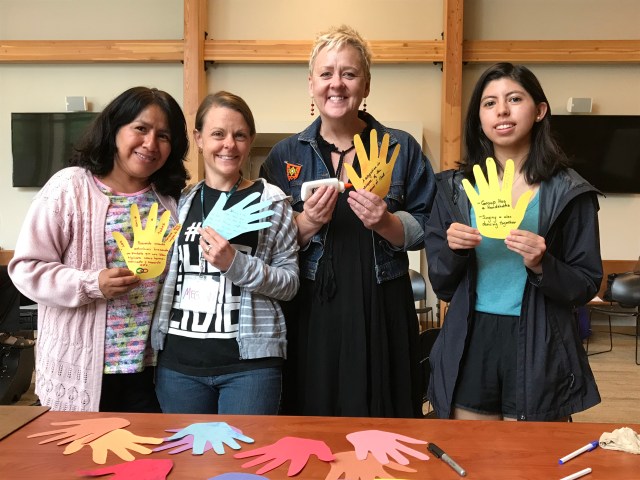
Open Delegation Stories 1: Saint Oscar Romero and current realities in El Salvador

by Cathy Burrell

Our group met together for the first time at breakfast. After introductions and a brief orientation, we set off for the day.

Part of our group outside the Divina Providencia chapel.

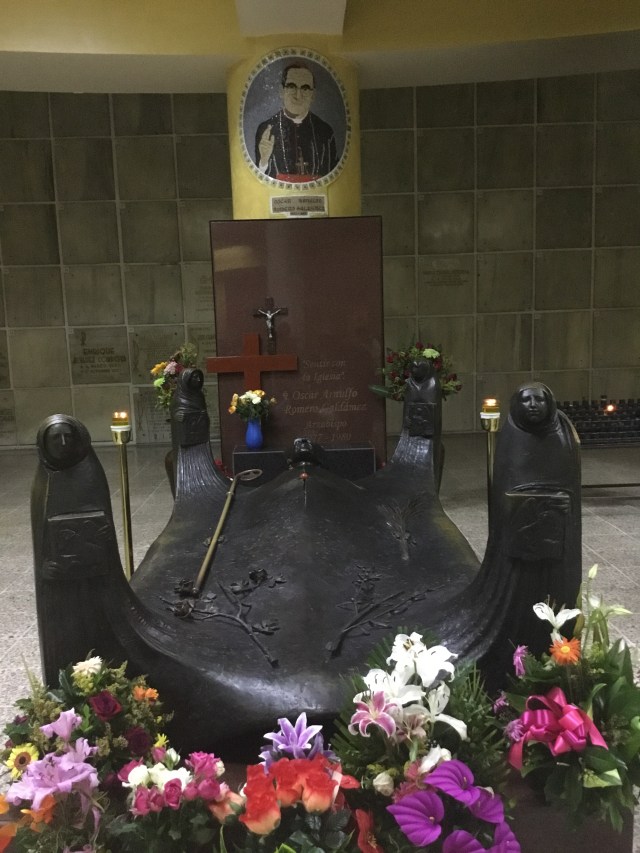
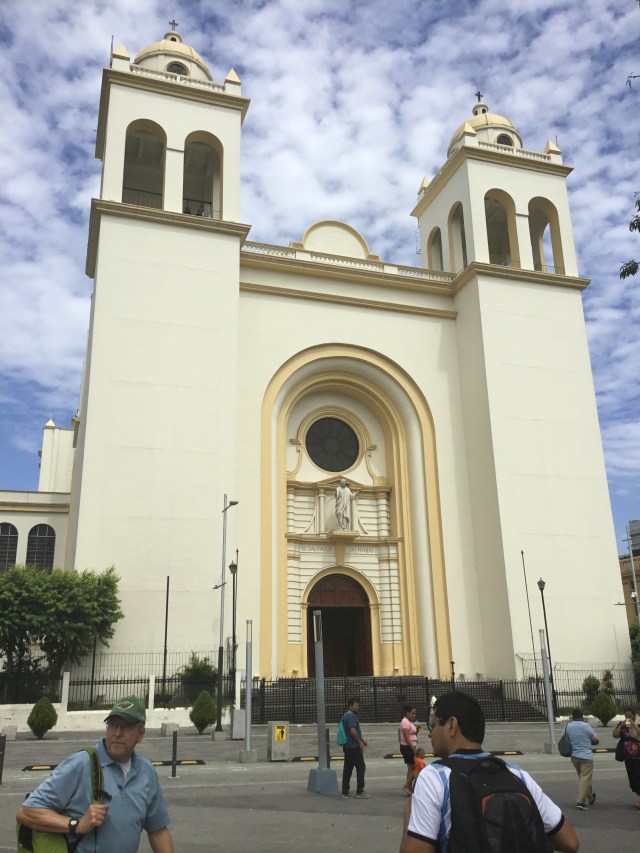
Our first stop was to Divina Providencia in San Salvador. This is the site where Oscar Romero was assassinated in the chapel while offering mass on March 24, 1980. We then visited the small house (now a museum) where Saint Romero lived while he served as Archbishop of San Salvador. This was a powerful experience as we learned about his life. Saint Romero spoke out against poverty and social injustice and it cost him his life. Next, we visited the National Cathedral and the crypt where Saint Romero is buried.

We had lunch with the crafts cooperative ACOMUJERZA in Zaragoza. We had presentations about the cooperative and their Sister Parish relationship with People of Hope church in Rochester, MN. The cooperative offers crafts with the role of helping to transform the lives of women. Eneyda Ramos from International Partners in Mission gave a presentation on economic policies and their impact on violence, migration and the environment.

Learning about the ACOMUJERZA cooperative in Zaragoza.

After a delay due to heavy rains we returned to the guest house. Sofia Baires shared stories with us about migrants who have returned to El Salvador after being deported by the United States. Sofia is a coordinator for CIMITRA, a network that advocates for returning migrants.

It was a long but a day filled with lots of information and powerful stories.

Memorial for Saint Romero at the National Cathedral.

Our group with one of the murals at Divina Providencia.

Staff member Julieta and her mother Maria Julia.

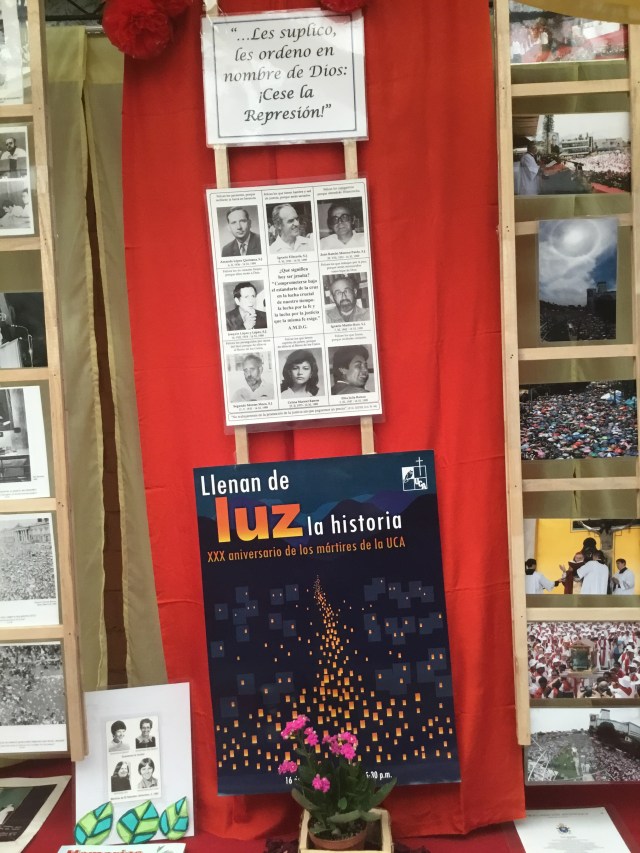
Pictures of the 8 people who were killed at the University of Central America in 1989 and a poster for the 30th anniversary mass.

National Cathedral in San Salvador.

Central Park in San Salvador.

Divina Providencia chapel where Saint Romero served and where he was murdered.

Outside Saint Romero’s house, where his organs were buried.

Posted in Delegations, El Salvador, North to South, southern encounter | Tagged , , , , , , | Leave a comment

Walking in solidarity for 25 years – St Joan of Arc

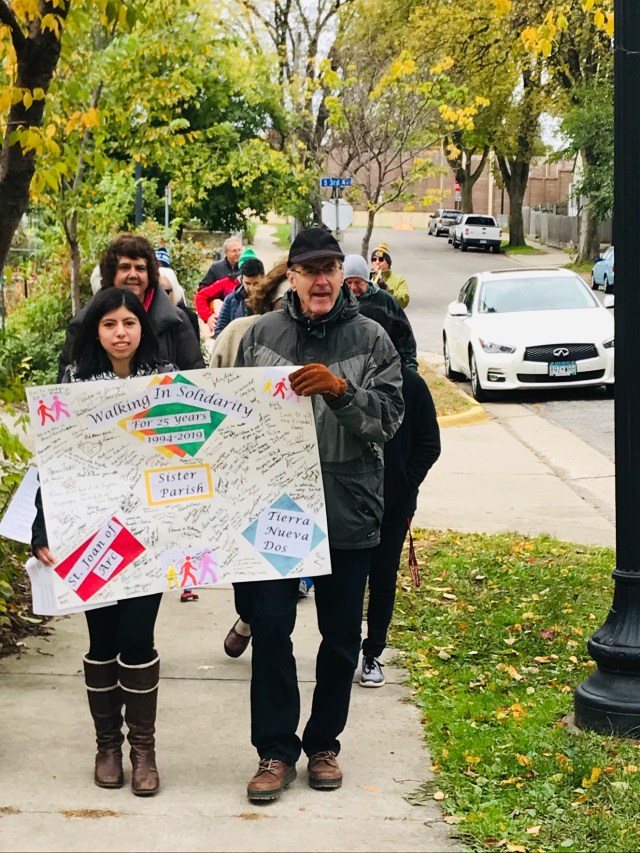
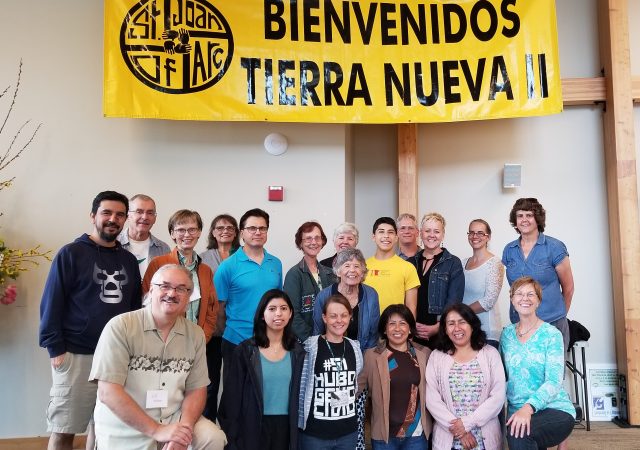
On a recent blustery Sunday morning, 20+ parishioners gathered for a high-energy Solidarity Walk in the St. Joan of Arc neighborhood with several stops for reflection and prayer. We lifted up our 25 year relationship with our Sister Parish in Tierra Nueva Dos (TNII) in Guatemala, and we carried a banner covered with parishioners’ signatures and well-wishes collected after both masses.
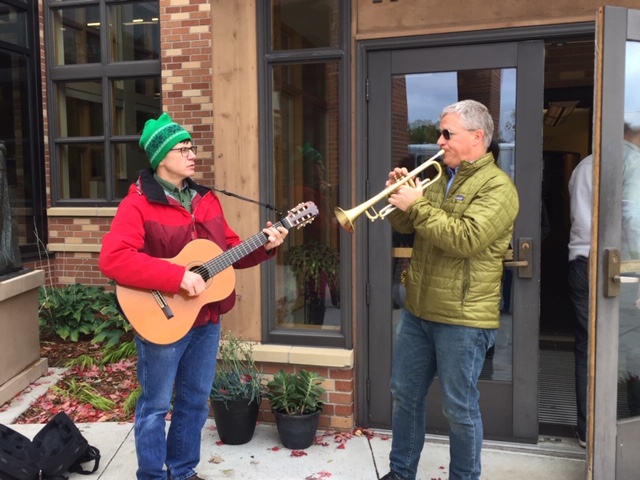
Our time together was filled with remembrances of our TNII family, mindful discussions about our relationship’s impact on our faith, our lives and our commitment to justice, and joyful songs with beautiful instrumental accompaniment. After the Walk, we warmed up in the Welcome Center with food and fellowship. Thanks to all who participated!
Posted in Anniversaries, Solidarity Walks | Tagged , , , | Leave a comment

A magnificent delegation trip to Guatemala….reflections after 21 years of relationship with people of faith in Central America

by Bill Williams

A rocky road to start…. a delayed flight, a missed connection, a flight to Guatemala City that should have been a few hours morphed into 2 days and nights in airports. But after finally arriving, we were ready to journey into the swirling spiritual, colorful, and connecting time with new and old friends, and cultures we have come to know and love.

Some soaring good news to encapsulate the story: Our brothers and sisters from San Antonio Quiche who journeyed 7 hours by bus to accompany us for 3 days in Antigua delivered the news that our relationship has reached a point of partnership and trust, that their traditional community is open to suggestions and connections that can help them build a sustainable future in the threatened land they call home.

Breakfast with members from San Antonio and Danville – reunited!

They asked for help – specifically not in money, but in sources of learning and growing – around their challenges in agriculture, energy, medicine, education, water.  We also talked about ways to lift up some of their lost traditions (traditions that they can still re-teach and find markets for) that we might support. And we learned about additional challenges from both military oppression and extractive businesses [supported by government and military] that threaten their land ownership, or the contamination of their land and water – as well as threaten their traditional way of life. In the case of those exposing corruption or organizing for change – their lives are sometimes also threatened.

Our delegations visit started out with some orientation to Guatemalan reality in Guatemala city. Carrie, our Sister Parish director, found everyone a lovely accommodation in a Catholic center devoted to teaching young women how to prepare for- and protect themselves- as they enter private service in homes, The spirit of the nuns seeing to our comfort, convenience and food was beautiful.

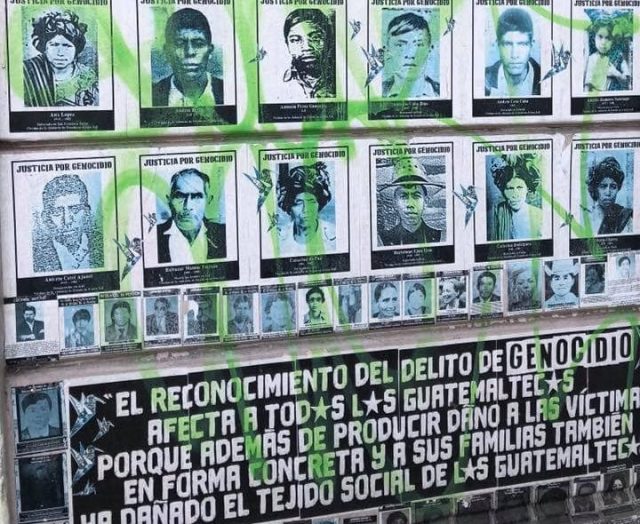
Carrie arranged a compressed set of introductions to history and beauty, weaving traditions and horrors.  Our tour included a visit to the Cathedral with monuments similar to the Vietnam memorial, with the names of many of the  indigenous victims of U.S.-supported genocide on stone columns. And also to stories of groups fighting hard for justice in court cases and folk festivals designed to organize and protect indigenous communities.

Picnic with Sister Parish members at Kaminal Juyu archaeological site.

We journeyed to an archaeological park for a picnic, where we were greeted by a group of women from another Sister Parish-linked community poised on the brink of a steep ravine at the city’s edge. How does joy arise among a group of people who have never met before? It did – passing through the gateway of acknowledged faith and commitment to partnership in the building of the reign of God. We shared the refreshment of friendship and fun. Names, games, food, dance, walking in history, and celebrating children playing together [little 3 year olds Estrellita and Emilio]. We parted in hugs and love. People left refreshed and grounded in the knowledge that they have friends from the faith and the North who will continue to think about them, pray about them, and return to them.  I know of the struggle they were returning to in their daily lives surrounded by violence. And I saw the hope and joy in their faces that our visit had been to them…. bread for the journey. We would see it again in this trip.

Although in this delegation we did not get to stay in San Antonio homes or engage with their larger community, we all experienced the opportunity to get to know both those in our delegation more personally and intimately, as well as to cross connect with people from San Antonio. Exploring, cooking, eating, reflecting, playing, singing. Shyness, strengths, vulnerabilities, visions, smiles, delights, needs, faith, talents, all arising from the kitchen and the clothes line and the garden.

All our communication was slow, translated from Quiche to Spanish to English, and back again. But the process allows for time to be reflective, and to pay attention to cues that are completely non-verbal as the tones and expressions of the kaleidoscope of faces create the totality of that communication. All of that verbal communication happens through the filters of our profoundly gentle and skilled facilitators, Carrie and Brian…. years of cultural interaction  to help get the real meaning across, and to bridge the moments of cultural misunderstandings with cautions or suggestions…. all delivered in tones and carefully chosen words that create an image of how Christ might have been in such a setting.
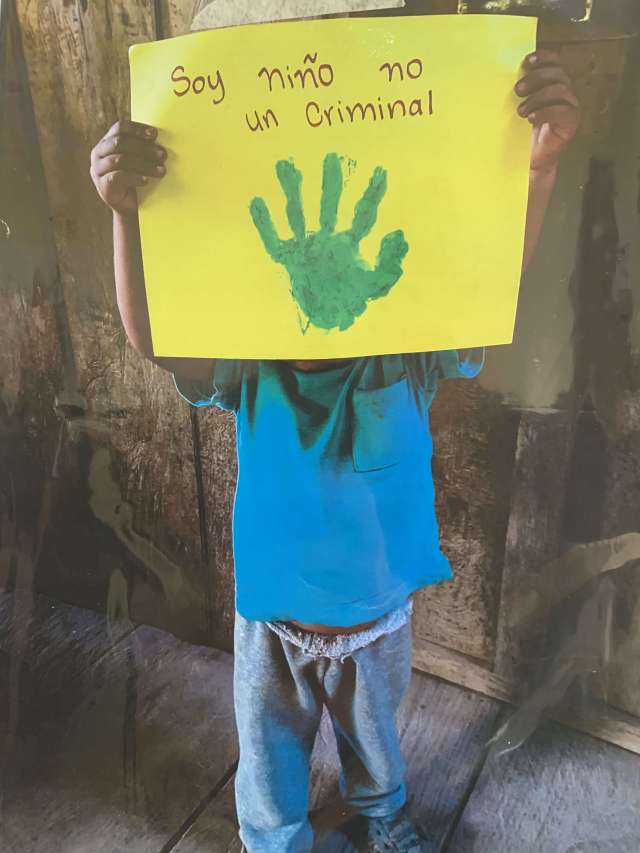
“I am a child, not a criminal” – picture on the wall at Pop No’j office.

In Guatemala City, we were introduced to Silvia from an organization called Pop No’j. They have developed a program of accompaniment for indigenous children being returned after separation from their families at the U.S./Mexico border. They provide care in the native language to children under the age of 18, and we heard of cases where the children were very young, including a 3 year old who received counselling after experiencing sexual violence in the U.S. detention center. Silvia is a young woman herself, tender and poised, still studying social work in the university, which likely describes many of their staff who are engaged with a case load of 54 children. She described their clients as “those who are the most cut off from opportunity”, and that they saw migration as an “act of love for supporting their family”. Their work focuses on re-integration, and extends into the family after reunion- providing all the social services you would imagine such a situation requires.  The organization is operating knowing that the case load they are managing now of 54 is expected to swell next year as 2,000 children are expected to be returned to Guatemala from the U.S.  Although the organization does not currently have the capacity to address the issue, many of the families are also going to face a huge debt they incurred in trying to cross the border. A recent returnee I know from Mexico incurred a debt of about $7,000 to cross the border. The families are usually driven to migrate by poverty, so how they will deal with that debt- and often the threats of violence that come with it- are a heartbreaking concern outside the purview of this group.
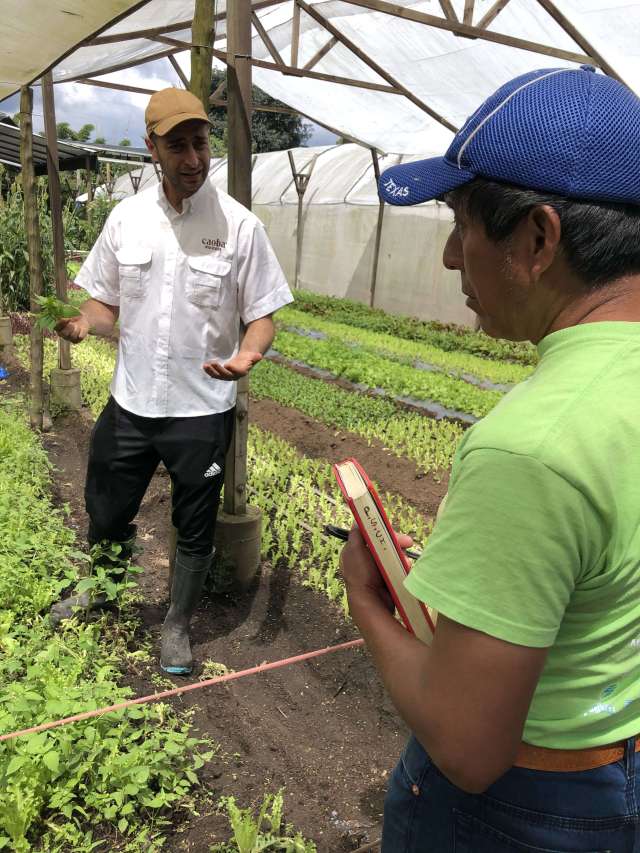
Tour at Caoba Farms in Antigua.

Probably the highlight of our time together for our San Antonio folks was our extensive tour of the organic Caoba Farms on the outskirts of Antigua. The farmers from San Antonio were bright-eyed and riveted to descriptions and demonstrations of techniques that reminded them of how their ancestors had done farming…. and of the possibilities it held for them. Everyone was delighted to receive packets of organic seeds and cuttings, plants and small tree branches to plant at home – some of which they had never encountered before.  The farm owner suggested they use the seeds from the plants that did the best in their environment [above 8,000 feet!] to create their own personal seed bank for the future. When they got on the bus to go home from Antigua, they looked like they were carrying a small forest!

We also were blessed to have a university linguist, Ajpub from Aid in Education, make a presentation to our group about his efforts to uplift the languages and cultures of indigenous Maya.  He spoke – first in Quiche, then in Spanish, then translated to English – about a program to support children, youth, and young adults in pursuing further education, both formal and cultural. The program identifies students and families who want to pursue schooling, but are too poor to achieve that goal. At the level of elementary school, the program supplies the costs of uniforms and books, and during vacation, they organize a vacation school for instruction and play in the children’s language and culture. For those who want to continue in university, matching donors are found in the U.S. for scholarships that typically cover half the cost. This is a program that Linda and I have been involved with for many years, and we wanted to know if our community of San Antonio would be interested. As Ajpub finished his presentation, the group from San Antonio responded by calling him “brother” in their struggle. Tomas noted in his reflection that it was important that they not produce “unprepared students” for their struggle. And the good news here is that Ajpub has already received phone calls from parents of children in San Antonio who want to explore possibilities for their children.

Lake Atitlan – near Mesoamerican Permaculture Institute (IMAP)

After our San Antonio friends left for their homes, we journeyed to Lake Atitlan.  A beautiful and unexpected part of our experience came from following Pastor Todd’s request to learn how “the day of the dead” is celebrated in Guatemala. The group from San Antonio had wanted to return to their community to celebrate that event at home with their families, so we went to visit a town on the shore of Lake Atitlan – the third largest volcanic caldera on earth- and one of earth’s most beautiful places. We asked a young woman who Linda had sponsored to study in the university over ten years ago to guide us through the way her family celebrates this day, which is seen as a day to refresh your connection with your deceased family. Dinora took us first to her home to meet her family. We traversed a very narrow hallway strung with laundry. Her mother supports the family [9 children] by washing laundry in the nearby lake. This encounter turned out to be one of the most spiritual times of our entire trip. Dinora’s dad is in failing health, but his handshakes were strong…. and the mother’s smiles and embraces were just as profound…. and they moved out of a connection of love and appreciation for what Dinora had been able to achieve by her university training to become a teacher. They were so proud of her, and so open to sharing their pride with us and all our friends…. they just opened their hearts to us all. Surrounded by about 12 people from the family, our 8 delegates from DCC sat together with them, received their prayers, and basked in the smiles of siblings and grandchildren [ in the tiniest room imaginable to hold us all!].
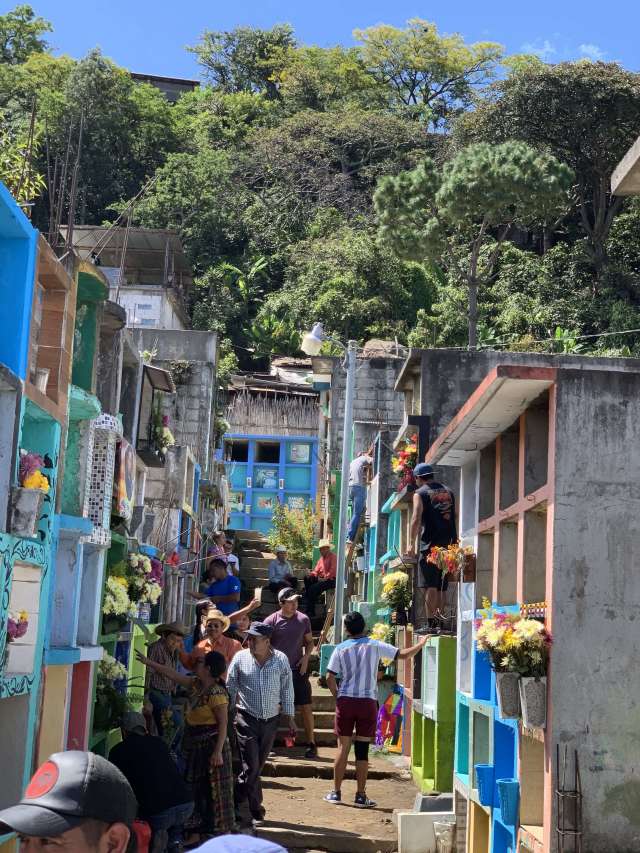
Cemetery in San Pedro.

This was the afternoon of preparation for the celebration that would be that night and the next day. Dinora took us to the local cemetery, which was being built up like a rising set of condo’s because the land was locked within the town, so the only way to go was up [except for a few graves that belong to families too poor to construct an above ground concrete niche]. People were everywhere, repainting and re-stuccoing, bringing fresh flowers, strewing the areas with flower petals, leaving traditional Mayan treats and incense… and a few kites were in evidence that would be gloriously arrayed the next day. As we left the cemetery, she took us by the craft stall that her brother Noe has grown to sell his art of stone and metal, and sell other local crafts and art. Our group joyously dived in to the wares, and I was delighted to find a portrait of a young boy to hang in our church.  As we left Noe’s stall, he told me that he would be donating 3,000 Quetzals to the local church for the poor.  That amount of money about equalled the amount of goods that all our group purchased from him that day. As we left, Dinora announced to us that she was engaged to be married. Her fiancé was a principal of another local school. She was beaming. We asked her age, and she told us she was 30. We followed that up by asking what the usual age for marriage is in her town and she replied, ’15 years old’. She had followed her dream along her own path. We later reflected that other young women who had been sponsored to go a university had followed the same path – many deciding to pursue education before marriage.

That evening during a reflection, our facilitator Brian Tyler made the comment that supporting Dinora’s dream had “changed that family’s trajectory”. Two of Dinora’s younger siblings had decided they too wanted to go to school – one had borrowed money from the bank to enroll in the university, and a younger brother was doing an internship in engineering to prepare for a university engineering program. Both of them were so bright eyed!

Seed bank at the Mesoamerican Permaculture Institute (IMAP)

We visited the coffee co-op CCDA (Small Farmers’ Committee of the Highlands) and met with Marcelo, who worked on a big coffee plantation for many years.  He described the CCDA’s work in producing, training, educating and organizing. CCDA tries to provide economic alternatives to families in the region.  On the large coffee plantations, the wages for current pickers and processors during the coffee season have stayed about the same over the last 35 years, and typically include a food ration just barely survivable for single adults- but no addition for the children they bring along. Over the last 10 years, the requirement for the amount of land each worker is responsible for clearing and maintaining has increased in size six fold. Since no single man can do that much, they are forced to bring their families along to help. Mothers still lose children to widespread malnutrition during the harvest season [ something described in the book “I, Rigoberta Menchu” published in 1984, 35 years ago]. CCDA effectively elected a member of congress in the previous term, in a campaign called “Take Back the Power”.  But when that politician opposed a mining company’s expansion, he was defeated in the last election by a campaign heavily financed by that company – that put campaign workers in every town in the district.

These coffee plantations, and the sugar cane fields [back-breaking and kidney -destroying places to work], are the places people from San Antonio go to work for the months when they can earn the tiny bit of money they need  beyond the food that they grow themselves. Both industries are controlled by a tiny number of wealthy families, who continue to extract wealth from the work [and land originally lived on] by the people they now treat as disposable workers. I met a premium coffee buyer along our way and in a heart-rending conversation, he told me that we are after the same thing, that workers are being squeezed harder and harder, and that we must find a way out of the grinding greed of this system.

Why can’t rural farmers sell a portion of what they grow to generate that extra money they need? Because their land holdings are so small.  Nationally, Guatemala has also been affected by free trade agreements and cycles of debt and repayment and ‘structural adjustment’ policies through international institutions like the World Bank and International Monetary Fund.

Many forces that have continued to marginalize and brutalize people blossomed from the U.S.-supported coup carried out in the support of the United Fruit Company in 1954 – a coup to overthrow the democratically elected president. That president had created many social institutions to benefit the population and had decreed that unused land would be re-purchased by the government, at its declared value, for subsistence farmers. He was deposed by a coup, and replaced by a series of dictators who could only maintain their power by military oppression. Those dictators continued to be supported by the U.S. – in the form of military training, funding, arms, loans – even through the most brutal regime of Rios Montt. This was a military general, and evangelical pastor, who was presented to Congress by President Reagan as “a man of great character”. This is the leader who was in power during some of the most brutal years of the war.  Now, decades after the official end of the war, the root causes and long-term effects – inequality, the concentration of land ownership, and increasing gang and drug-related violence (often with roots and connections to the military violence during war) – continue to affect the Guatemalan population.

Global warming has also had a huge impact in recent years. The people in San Antonio this year experienced a protracted drought, followed by such heavy rain that many lost their entire crop. They will not have food next year. Those families face a huge question. “How far will you walk to feed your family?” The U.S. is the largest contributor to global warming in the world. We are also the only place  people can send their young men to make the money necessary to feed their families. The attitude we encountered around that Northern trek was one of pride in the love that moved these young men to leave everything and everyone they loved, and venture North to find work for the few years it would take for them to send home enough to supplement their family income, and probably enough to build a concrete block home on their return.  Maybe even enough to supply a stove and chimney that would take only half the fire wood of the typical open fire in the home [Lucia told me that she spent most of every day collecting firewood], and protect the families from the ravages of respiratory illnesses that smoke inflicts.

How people in San Antonio see global warming? It is in their face and daily life. They describe how over the last 20 years, springs that had run for all memory have ceased to run. No one during our trip mentioned the role of the U.S. in this predicament, but the people in San Antonio know that cutting the trees from their hillsides once refreshed by adequate rain, had led to barren slopes. And they want to be replanting trees! But water has become the most divisive force in their community – as they face the need to sink a deeper and larger well just to sustain their lives.

There is good news.  We can change the politics between our two worlds, and we can work with people in San Antonio to partner in rebuilding a sustainable and dignified life in their home land that celebrates and builds on their unique place and traditions.

Much of the oppression that people experience in Guatemala has been, or continues to be, influenced or caused by policies of our own government. We can pay attention. People need us to change our politics.  We can demand politicians and institutions that lift up human life and dignity and possibility. We can make personal choices about our purchases AND participate as informed and engaged citizens in our democracy. Let our congressional representatives know that we demand trade agreements that benefit both sides. Let our dinner conversations with friends and family move into the lives that you now know which are being crushed by global warming – they need action now. Become an advocate for immigration… both for policies that relieve the causes that drive it and for work paradigms that serve human interests in both our countries. We can direct foreign aid at water projects and education, sustainable agriculture and reforestation, not military aid- that classic source of violence that sustains oppression. We can humanize our refugee policies for those running for their lives, whether that is from physical violence threatened by drug gangs or spouses, or whether it is from starvation. Let our local candidates know these are concerns of ours.

As we live into the relationships we have forged through love and faith, how do we find our place in this world? Justice. You are called. I am not the only one calling you.  They will know we are Christians by our love. We will know we are Christians by our love.
Posted in Delegations, Guatemala, North to South | Tagged , , , , , | Leave a comment

Danville Congregational Church visits with San Antonio

by Bette Felton

Delegates and Sister Parish staff on Guatemala City historical tour.

It was a wonderful, refreshing trip, starting in Guatemala City.    We visited three amazing programs before we went to Antigua to meet our 8 friends from San Antonio.    We visited the Popol Vuh, a Mayan museum that has amazing time lines, ancient altar pieces, mural revivals and hieroglyphs from personal collections.   The museum is in a private university, Universidad Francisco Marroquin- considered home of right wing rich families for university studies.   However, they have assembled and curated an amazing history of the many of the Mayan cultures.   And next door was a remarkable textile museum with maps and ‘huipilies and cortes’ from more than 50 towns and regions in Guatemala.   There were displays from the early 1800s and you could see the evolution of weaving and style over the years.  We also shared a laugh filled picnic with women from Tierra Nueva 1 and 2-two Sister Parish communities in Guatemala City, in an archaeological site with Mayan pyramids called Kaminal Juyu. It was from this archaeological site that an exquisite altar piece in the shape of toad on display in Popol Vuh.

Picnic with Sister Parish communities at Kaminal Juyu site.

We visited for 3 hours with Lisa Rankin, from Canada, who works with Breaking the Silence, an organization that monitors and exposes extractive industries, primarily mining,  in Guatemala.  Most mines are run by multinational corporations who have done deals with the Guatemalan government for rights to mine, pollute water, grow palm in plantations, etc.   Citizens have no recourse except to organize and protest and let the truth be known.  Lisa is another former ‘accompanier’ who works diligently to follow Hudson Bay Minerals (now Russian owned) and the Escobar Mine in particular.   She seems to really know international labor rights and encourages community consultations, like the one our sister community has done.  We were connected and introduced to these amazing folks by the courageous Carrie Stengel, who is the Executive Director of Sister Parish.   Along with Bryan Tyler, also from Sister Parish, we were shepherded to remarkable places and  people, each one more interesting than the one before.

We also talked with an amazing digital activist and future attorney Andrea Ixchiu who with her partners, organizes Solidarity Festivals in communities all over Guatemala, trying to raise awareness about extractive industries and the harm they do. She thinks that militarization is the current fear, with a government that considers organized citizen groups as enemies of the state.  The military feels able and willing to do ‘exceptional interventions’ in 22 communities that have organized around climate change.   The charges that the community activists are ‘narco-organizers’ is completely erroneous according to Andrea , but it stimulates more fear and justifies the declaration of  ‘states of siege’ (similar to martial law) in rural communities and counties.  Another interesting trend is the privatization of security, and the people who own and manage these private security firms are the old guard from the civil war of the 80’s- friends and family who now are making huge profits, ‘protecting’ the rich.  In small and rural communities, there is fear that these private security firms are a return to the civil patrols of the civil war that rounded up fellow citizens, and often caused their deaths.

“I am a child, not a criminal” – picture at the Pop No’j office.

Before we greeted our ‘hermanimiento’, on 10/28 in the morning, we went to Pop No’j, an organization that provides accompaniment for returning and reintegrating children who have been separated from their families by immigration authorities in the U.S.  We were greeted by Sylvia, a social worker who described the mission and services of this organization that is focused on indigenous communities, primarily in Huehuetenango, a northern province that has along the border with Mexico   Their migration program started in 2010 with assistance from the ELCA (Evangelical Lutheran Church in America), and KIND (a US non-profit organization-Kids in Need of Defense).   They consider migration an act of love, that families find they must do together if possible, to provide futures for their children.  They are currently supporting 54 children and their families (as of present day) as the children return home and reintegrate.  Many of the kids have been in the same detention centers in the U.S.,  and are referred to Pop No’j from agencies in the U.S.  Social services Pop No’j provides in the families’ native language include home visits, education, health care and counseling.  Pop No’j coordinates with local hospitals and municipal governments when needed..  Sylvia shared two very serious facts:  More than 2000 Guatemalan children have yet to be returned, and in 2018, U.S. ICE agents have been training and participating in operations with local police, so the crisis continues. U.S. Department of Homeland Security agents are operating at the Mexico/Guatemala border in Huehuetenango.   I later asked my Congressman about this, and he replied,  ‘I am not at all surprised.’

After Pop No’j in Guatemala City, we traveled to Antigua to meet our friends from our Sister Parish in San Antonio, Quiche. We were not able to do home stays in San Antonio this time due to some local community tensions. Fortunately we were able to be together for 4 wonderful days with 8 of our friends who travelled 6 hours from San Antonio to Antigua.  We laughed and cried, and played and cooked with Tomas, Maria, Pedro, Guadalupe, Lucia, Yoselin, Manuel, and Leslie. And we were accompanied by Brian Tyler, Carrie Stengel, her son Milo, her brother in law, Estuardo, and the remarkable driver, Martin.   Our Casa Don Pedro was a very large house with room for 20 of us.   A staff of two women helped serve us meals, except when we cooked with our friends.

Breakfast with friends – San Antonio and Danville communities reunited.

One highlight of my stay was grocery shopping with some of our friends and Milo, especially after a cool exercise that Carrie had us do in Guatemala City.  Before we met up in Antigua, Carrie had the Danville bunch shop with 100 quetzals (about $12-$13)  We shopped for a week’s menu for 4 and realized how difficult it would be to provide adequate nutrition with limited funds.   When we actually did shop for 20 (2 meals), we were made aware of how far their income is stretched.   And we were reminded of why beans with tortillas, made on a wood fire, provide almost 100% of their nutritional intake. Our American diet is so varied, and caloric that three adults could have adequate nutrition and satiety with only one of our daily intakes.

Almost a full day was spent at Caoba Organic Farm in Antigua, where the founder, Alex, spent almost 4 hours describing and showing us the animals, and vegetables and fruit that he produces.   Alex came from Wyoming and started growing romaine lettuce in 2008 for the growing ex-pat community in Antigua.   He spent intense time with Tomas and Pedro, learning their needs-high altitude farming and climate changes-and then recommended trees, composting, and other practices to improve their crops. He also provided seeds that work at high altitudes and talked about the importance of harvesting seeds from your first crop, to use the following year (which farmers in San Antonio absolutely do with corn and beans).  The gardens were beautiful and practices were on display to provide information to San Antonio and Danville farmers.

Tour of Caoba Farms in Antigua.

And then there was our time together. That was the reason for our trip.   As separate communities, we worked up a tree of life-where we started and where we are going- and presented them to the other community.   We taught each other songs, and did the hokey-pokey.   We heard from Linda’s friend from Aid in Education, that described the process for finding students who want to continue in school.  We became comfortable with saying ‘Maltiox’ (thank you in Quiche) and ‘Saqarik’ (good morning in Quiche).  We heard their joys and concerns and talked more about how we can support each other going forward. Being with people of faith from San Antonio, Sister Parish, and Danville Congregational, I have gained confidence that our shared journeys, and the love that surrounds them are the real thing.   Authentic relationships, based on faith and love, are what we need to find our place in this world, and it was a privilege to feel it and share it on this trip.

Maltiox to all of you awesome ones!

Posted in Delegations, Guatemala, North to South | Tagged , , , , , | Leave a comment

News related to our sistering relationships – September 2019

In Guatemala, the conservative former head of the prison system, Alejandro Giammatei, was elected president in an August run-off election.  He will be inaugurated in January 2020. The United Nations-sponsored International Commission against Impunity (CICIG) gave their final report before their mandate runs out this September.  On September 4, the government declared a State of Siege in 22 eastern municipalities following a security incident during an anti-narcotics operation.  The State of Siege has many implications for social movements in the area, as it severely limits the rights to assembly and protest, among others.

In El Salvador, the new president faces pressure from both the right and the left.  NACLA published an interview with social movement leaders about his first 100 days in office. One recent study found that El Salvador will run out of water in 80 years, unless drastic actions are taken. This is not surprising to the many communities living without access to adequate water, nor to the social movement in El Salvador that has been demanding action on water and climate change for years now.  In July, a judge expanded the charges in the case of the 1981 El Mozote massacre to include torture, forced displacement, and forced disappearance.

United States government officials continue to negotiate agreements with Honduras, El Salvador and Guatemala to address migration rates.  Trump used harsh threats recently, including higher taxes on remittances and a travel ban on Guatemalans, to pressure the government to sign an agreement establishing Guatemala as a “safe third country” for asylum seekers.  Both his threats and the “safe third country” agreement were widely criticized in Guatemala.  The U.S. is sending more Border Patrol agents and Department of Homeland Security personnel to Guatemala and they will be trained and deployed “side-by-side” with Guatemalan security officers.

Posted in El Salvador, Guatemala, News, United States | Leave a comment

St Francis visits Las Margaritas 2 in Guatemala

The Catholic Community of St Francis of Assisi in Raleigh, North Carolina visited their sister community, Las Margaritas 2 in Guatemala, in July of 2019.

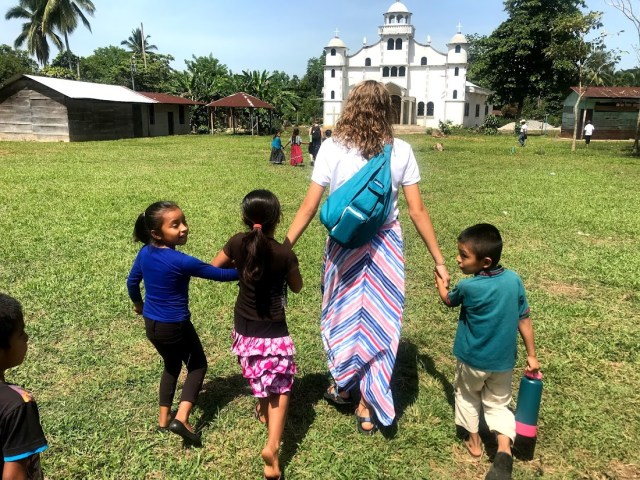
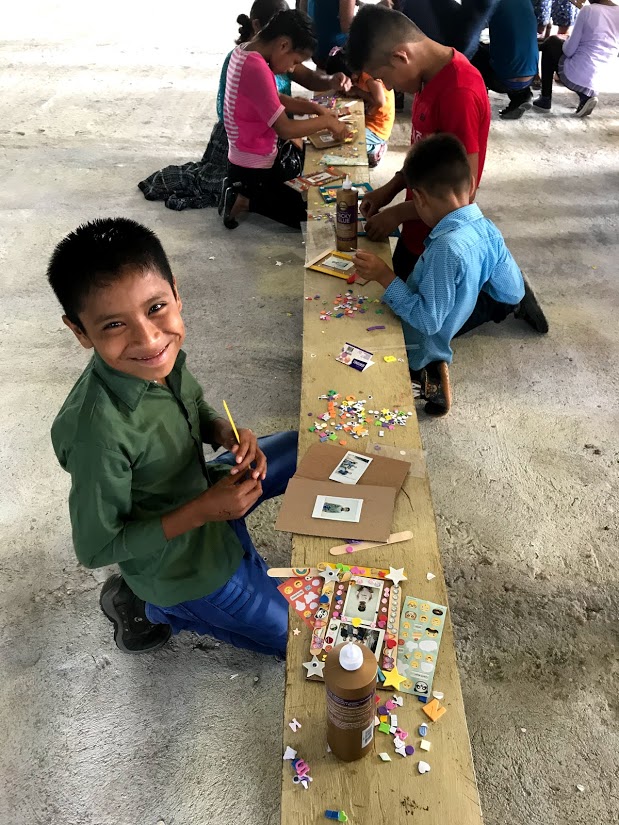
Art project with the children in Las Margaritas 2.

Accompanied everywhere we go by the children of Las Margaritas 2.

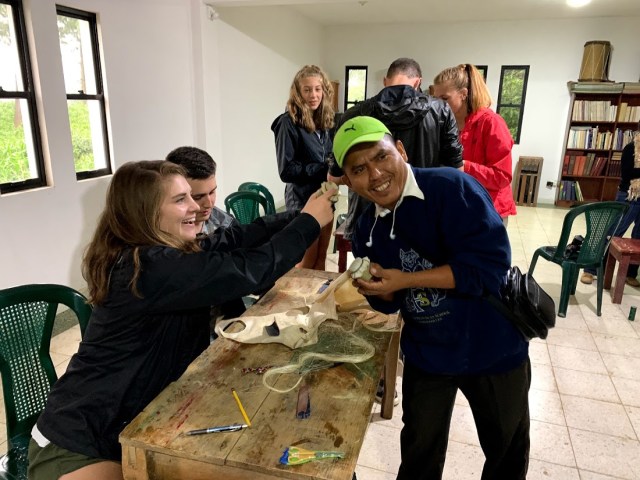
Learning at the Sotz’il Cultural Center.

Presentation at the Sotz’il Cultural Center.

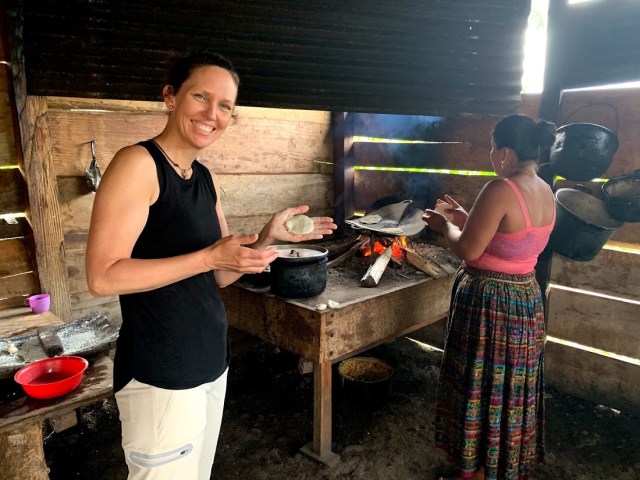
Learning how to make tortillas.

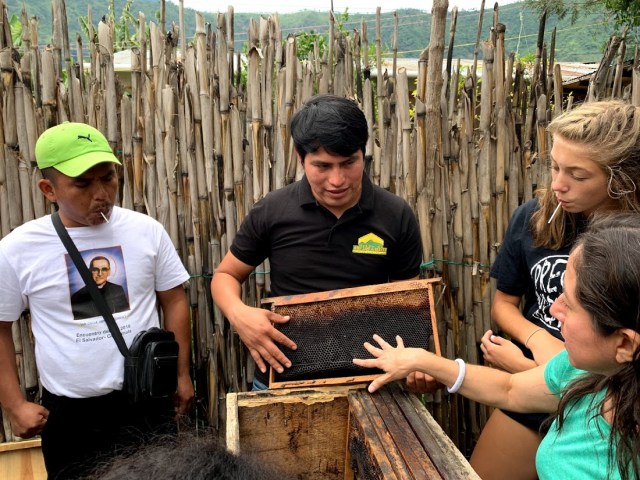
Learning about traditional beekeeping.

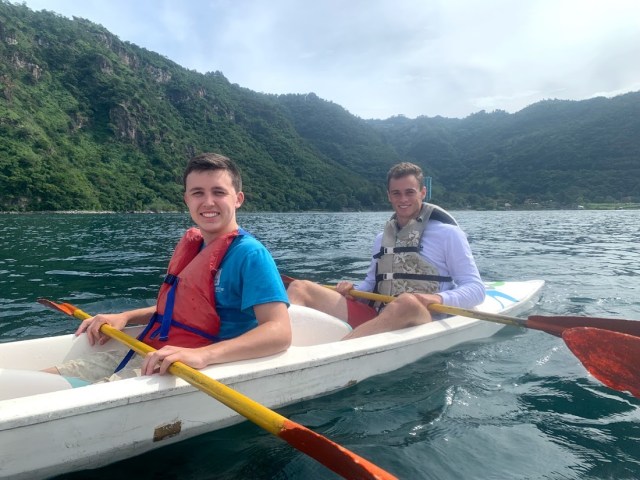
Kayaking on Lake Atitlan.

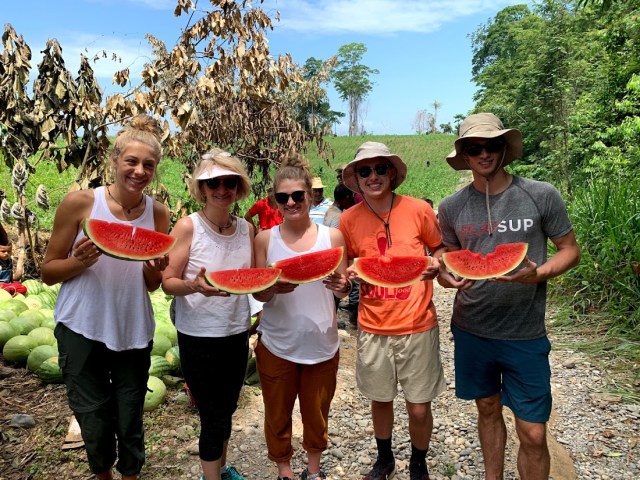
Delicious watermelon in Las Margaritas 2.

Art project with the children in Las Margaritas 2.

Posted in Delegations, General, Guatemala, North to South | Tagged , , , | Leave a comment

Downers Grove FUMC visits UPAVIM in Guatemala

Originally published in DGFUMC’s The Tower Bell newsletter.

In the middle of July, a delegation of eight people from Downers Grove First United Methodist Church went to Guatemala to build relationships with the women of UPAVIM (Unidas Para Vivir Mejor/United for a Better Life), and learn about Guatemala’s history and culture. [The delegates] spent a week building connections. For over a decade, DGFUMC has celebrated our hermanamiento (sisterhood) with UPAVIM (Unidas Para Vivir Mejor United for a Better Life), a Christian co-op in La Esperanza, Guatemala. Every two years, a delegation from DGFUMC visits Guatemala or a delegation from UPAVIM visits the United States. These visits and the time spent in prayer with, and for, each other are all about building solidarity.The delegation is grateful for the DGFUMC’s Guatemala Connections task force and all who made it possible for them to go! Throughout the next few months there will be opportunities to hear about their experiences and learn more about this beautiful relationship that we share with UPAVIM. A special family meal featuring a Guatemalan dinner is planned for Wednesday, October 9.

Visiting Chichicastenango together.

Visiting UPAVIM’s amazing children’s library.

Visiting UPAVIM’s amazing children’s library.

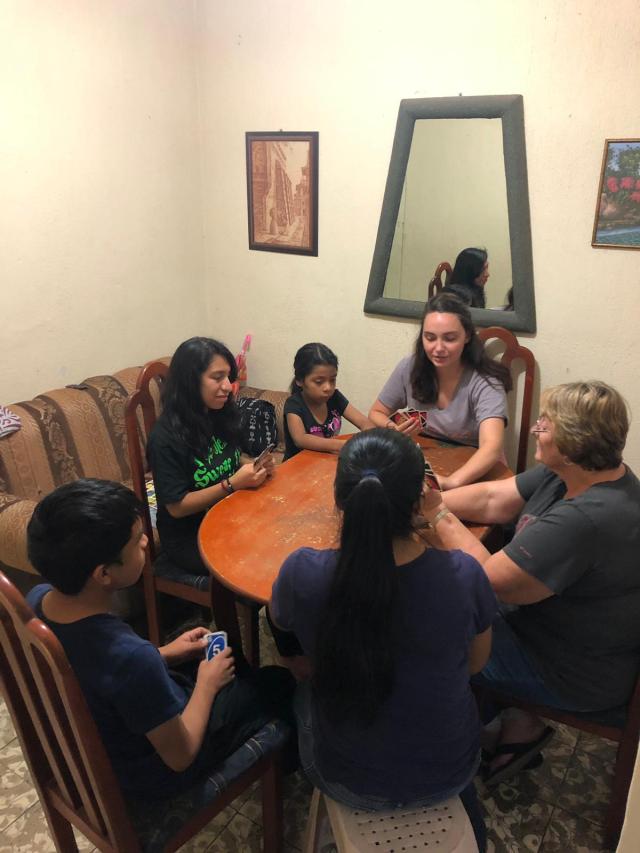
Playing UNO with homestay family.

Learning how to make UPAVIM crafts – and learning how hard it is!

Learning how to make delicious champurradas (cookies) in UPAVIM’s bakery.

Visiting Pop Wuj art gallery and learning about Mayan spirituality and art.

Posted in Delegations, General, Guatemala, North to South | Tagged , , , | Leave a comment

Reflections on our Journey to Tierra Nueva 1, Guatemala

Five people from numerous churches in the Fargo-Moorhead area visited Guatemala July 21-29, 2019 for a delegation with Sister Parish.  One delegate shares his reflections about the exchange.

By Charlie Jordan

After two months of rest and thought, I very much would like to share some reflections of our Fargo-Moorhead North to South Delegation to Tierra Nueva 1, Guatemala this past July.  Linda Graf and I from St. Mark’s, as well as Vicki Schmidt and two senior students from UND, made our way to Guatemala City in order to participate in a “friendship exchange of goodwill” with a Sister Parish congregation called San Marcos.  A West Fargo church had previously been the North American “sister parish” to San Marcos for many years.  This relationship between churches in North America and Central American congregations began in the early 1980’s as a way to show friendship and solidarity with people living in poverty and suffering political persecution in different ways.  Our experience focused on making new friends, exchanging cultural ideas and customs and living with folks from San Marcos for 4-5 days.  We had numerous cultural excursions as well, but by far, our greatest gift to give as well as to receive, was listening to the many stories of violence and family disruption due to an ongoing civil war in Guatemala.  This has led to the creation of new towns, starting as settlements with no public services of any kind, no roads, no water or sewer or electricity.  One such area, now 40 years old, is called “Tierra Nueva 1” or “New Land 1.”  Here we stayed with wonderful host families who cooked for us and welcomed us into their very modest homes.  It is a similar experience I have had several times in Spain and Mexico, but unique in Guatemala as it was my first visit to this country.  It was definitely the most rewarding aspect of our trip, in my opinion.

We first stayed in a religious retreat center in Guatemala City where we became oriented to the history, customs, food and climate of Guatemala.  They were modest but very comfortable conditions.  Our hosts were a religious order of women who cooked wonderful and plentiful meals for the guests of this retreat center.  We also spent our last two nights here on our way back from Tierra Nueva 1.  We saw government buildings, the main square, and a wonderful museum called the “House of Memories.”  There we briefly learned of Guatemala’s history, its colonization by the Spanish (and the atrocities they committed), human rights violations, the many missing souls due to kidnappings and war.  We also learned of the many heroes and heroines of this time, who spoke out against government actions against indigenous people and the (ab)use of land.  It was a lot of information to process and comprehend, but we had excellent guides provided by Sister Parish.  They live in work in Guatemala, hosting other church delegations.  One is from Minneapolis and another from Nashville.  Our third guide was from El Salvador—who happened to be free during our delegation, so she added much to our tour as well.

We made our way to Tierra Nueva 1 in a rented van and arrived about an hour later.  Guatemala City is very large with perhaps 2-3 million people, and where we were headed was about 40,000.  We visited families, widows and widowers, and people who have family in the USA, unable to leave to visit family in Guatemala for fear of deportation.  Many, many folks had tales to tell of friends and family who had gone north, some who have stayed and some who have returned.  We were made aware of the awful drug and gang violence present in the country, and consequently we were accompanied at all times.  We heard such sad stories of pain and suffering that caused many emotions for all of us.  I, being very emotional and hearing these stories twice in two languages, was very moved by their personal testimonies.  The photos we saw on people’s walls of departed ones, the religious icons and deep faith of these people, going through more than just hard times, speaks to their strength and will to continue on.  To see how little they had and how much they shared with us, was extremely humbling.  We were guests in their homes and in their country—making us feel like more than just new friends, but family members from far away, now reunited after many years.  The feelings of genuine concern for us and ours for them was very touching.  As my language skills warmed up from many years of not much use, I became more in touch with the current situation that seems to cause cyclical poverty and despair, from a government that has forgotten its people in some ways.  Especially those in Tierra Nueva 1.

Another excursion took us to the site of a recent volcanic eruption and the devastation that occurred in June 2018.  We visited a church where the priest had worked with volunteers from around the world to help provide temporary housing for families who survived, but lost everything.  Everything.  It was like walking on sacred ground, knowing many souls had been lost in the lava flow, as well as homes and businesses.  The remains of a church, believed to be full of worshipers, was almost too much to think about.  I was deeply moved by this visit; even more so by our visiting with a young man, collecting firewood for his mother, who survived the eruption and disaster.  Listening to his story of that day and  all of its details was simply a gift that coincided with our visit that morning. We greeted him and said “God bless you and your family,” then quickly collected some Quetzales ($$) to give him.  He was grateful and proud.  We all gave him a hug and moved on to visit Antigua, Guatemala’s old capital city and touristy town.  However, I didn’t move on that quickly.  The morning’s experience had me emotionally devastated, thinking of all that we have here and how little others have in this world.

Back in Tierra Nueva 1, we shared mass at San Marcos and were warmly greeted by their Filipino priest.  We sang in their choir that morning and heard wonderful songs of praise and thanks to God.  We had rehearsed that song with my host family’s father, Carlos Aguilar, who is a very accomplished singer and guitarist.  The previous evening we cooked a pork casserole dinner with potatoes and carrots for 120 of San Marcos’ members.  We served the people this dinner in the church’s fellowship space and cooked it in the priests’ quarters.  It was a great experience of collaboration, work and fellowship, led by Vicki Schmidt.  I think the people were fairly impressed and enjoyed themselves.  Dinner was followed by music and dance, provided by Carlos and Julieta, our El Salvadoran guide, serving as DJ.

On Sunday evening we returned to Guatemala City and then on Monday we visited UPAVIM, a community center for women and children, started with a woman from Texas in the early 1980’s.  Her husband at the time founded Sister Parish, which continues today all around the country and Central America.  UPAVIM employs women to make Guatemalan crafts, provides a day care and Montessori school, as well as schooling for children grades K-6.  Its name reflects its goal: Women United Together for a Better Life.  They have a US website where anyone can purchase crafts online in order to support this important center.  It also was a great highlight of our trip, an uplifting experience to know it exists for women who may find themselves as single parents or widows, without much family or government support.

Please remember that while we may call this a “mission trip,” our primary mission was that of greeting and living among our sisters and brothers in Christ.  We are all the same humanity, after all.  As a very popular Latin American song says, “Todos son iguales en los ojos de Dios,” or “Everyone is the same in the eyes of God.”  Sister Parish links churches together to share trips, experiences, family, friendship and culture with those in impoverished countries.  It builds bridges of understanding through faith and love, mutual respect for one another and commitment to improvement of basic needs.  Our current Sister Parish Committee is looking for a new church home, and St. Mark’s of Fargo may just well be that new home.  The committee just authorized financial aid to San Marcos of Tierra Nueva 1 to create an overnight trip/excursion for its youth to a cultural site in Guatemala.  Good things are happening there because of the support of folks in Fargo-Moorhead.  It was an honor and a privilege to travel there this summer.  It was a cultural exchange I will always remember.  As I told many, many students in my Spanish classes, even if you don’t use the language you’ve studied, it has opened a new door into new cultures, new experiences and a new awareness of others that no one can take from you.  As Americans, we should all strive to travel outside of our borders in order to realize what the world offers.  We enjoy many freedoms in this country and traveling abroad makes you aware of them and helps us understand where others come from.  Thank you to the members of St. Mark’s who have supported us through attendance at the Guatemalan Getaway Fundraiser and individual donations.  It is a very worthy cause to support.


Posted in Delegations, Guatemala, North to South | Tagged , , , , | Leave a comment

“Nuestra relación es como un anillo al dedo” – TN2 visita Santa Juana de Arco

Dos representantes de Tierra Nueva 2, Guatemala compartieron sus reflexiones sobre el hermanamiento durante la visita a Santa Juana de Arco. Se puede leer sobre las actividades de cada dia en el blog de Santa Juana de Arco.

English

Participantes en el retiro de cierre.

Alba Rivera:
Este año, celebramos 25 años de la relación entre Santa Juana de Arco y Tierra Nueva 2 en Guatemala.

Cuando llegaron las primeras delegaciones de Santa Juana de Arco nos visitaron en nuestras casas. Nunca habíamos tenido esta experiencia de recibir a alguien que no fuera familia. Creció nuestra amistad, hablamos sobre lo que podríamos hacer juntos y nos enamoramos.  Incluso hicimos anillos de compromiso.

Recordamos cuando venimos aquí, vimos cómo las mujeres de Santa Juana eran líderes activas en la iglesia. Vimos cómo hablaban en público y nos inspiraron. Recuerdo que Auri me dijo: “Necesitamos aprender a hacer eso”.  Tuvimos la oportunidad de que Mindy de Santa Juana fuera nuestro público en la preparación de un tema.  Con el tiempo, nuestra relación se profundizó y empezamos el proyecto de las mujeres para capacitar y formar a las mujeres en nuestra comunidad. Mujeres que estaban deprimidas, algunas que no salían de su casa, ahora vienen al grupo de mujeres. Las que recibían los talleres hace años ahora son las lideresas del grupo. Ahora vemos a las mujeres de nuestra comunidad sirviendo en la iglesia y hablando en público como yo.

Presentación durante la misa.

El hermanamiento nos ha ayudado a crecer en nuestra fe. Tenemos los compañeros en oración y la reflexión compartida. Sentimos alivio al saber que ustedes oran por nosotros y que nosotros oramos por ustedes, estamos conectados a través de la oración y la presencia de Jesús en nuestras vidas. Esta semana cuando fuimos a la misa en la mañana, era tan íntima.  Nos sentimos muy cerca de Dios y de todos ustedes. No entendimos todo lo que dijo el Padre Jim, pero la misa fue como tomar un café bien rico, o comer un plato de tortillas con frijoles y crema: no es mucho (no era muy larga la misa), pero es delicioso y justo lo que necesitábamos.

Esta semana vimos como a las personas aquí les interesa lo que sucede en el mundo. La gente levanta su voz por todos nosotros en la marcha por la paz en el puente.  Nos reunimos con la pastoral Bienvenido al Extraño y salimos en el camión de Panes Móviles. Escuchamos más historias de lo que pasa en la frontera entre EEUU-México. Queremos concientizar a los jóvenes sobre la migración y queremos dar pan a los hambrientos en nuestra comunidad también, y ahora tenemos más herramientas e ideas.  Nuestras experiencias aquí nos dan fuerza para trabajar más en nuestra comunidad.

Miriam Vasquez:
Quiero compartir que, en este viaje, lo que más nos ha impactado son nuestros momentos de compartir oraciones y compartir nuestras vidas. Junto con nosotros, ustedes entran en nuestro dolor y nuestra alegría. El esposo de Alba, Juan Carlos, falleció hace 3 meses y aquí hemos llorado juntos. Así es cuando alguien muere en nuestra comunidad, sienten el mismo dolor, y nosotros igual. Recordamos con mucho cariño a Padre George Wertin, Bob Heberle y Efrain Juarez y los otros que ya no están.

Con nuestras familias hospedadoras, sentimos una cálida bienvenida. Querían darnos lo mejor. En las familias siempre hay dificultades, pero podríamos ver cuánto amor tienen el uno por el otro y sentimos su amor también. No nos sentíamos extraños, sino personas que se habían conocido antes, que se conocían desde hace mucho tiempo. No sentíamos que estábamos lejos de nuestras familias.

Miriam con su familia hospedadora, Daymond y Valerie.

Miriam y Alba con Jeff.

Nuestra relación es como un anillo al dedo. Nos hemos adaptado con nuestras debilidades y vulnerabilidades, con mucho respeto. Como en todas las relaciones, hay desacuerdos, pero siempre hemos sabido cómo manejarlos. Así es como el hermanamiento ha durado 25 años. SJA nunca dijo, son pobres, solo haremos lo que queramos. En cambio, nos enseñaron que podemos tomar nuestras propias decisiones y que tenemos el derecho a hacerlo como seres humanos. El hermanamiento no se trata de servirnos. No es que uno sea mejor que el otro. Nos complementamos. Lo que uno no tiene, el otro dará con mucho amor, como un matrimonio.

Creemos que esto es lo que Dios quiere de cada uno de sus hijos, que nos amemos y que este amor nos acerca a Dios. Dios nos da un toque a cada uno de nosotros hacia la acción. Tal vez no siempre lo hacemos, pero él nos toca nuevamente para que volvamos a vivir como él quiere. Dios quiere que cambiemos el mundo en que vivimos ahora, un mundo con tanta impunidad, violencia y pobreza. Ustedes están haciendo su parte aquí y nosotros hacemos nuestra parte en Guatemala. La esperanza para un mundo más justo está en cada uno de nosotros. A través del hermanamiento nos damos cuenta de que no somos pobres. No estamos solos. Somos uno. Somos parte de un todo.

Gracias por estos 25 años de compartir.

Sirviendo comida con la pastoral “Panes Moviles”.

Reconociendo a las cuatro personas de TN2 que no recibieron una visa para participar.

Retiro espiritual al final de la delegación.

Juegos y diversión son parte de cualquier delegación.

“No más violencia en contra de las mujeres indigenas.” – Mural en Minneapolis.

Somos uno.

Posted in Aniversarios, Delegaciones, Español, General, Guatemala, sur al norte, United States | Tagged , , , , | 1 Comment

“Our relationship fits like a ring on a finger”: TN2 visits St Joan of Arc

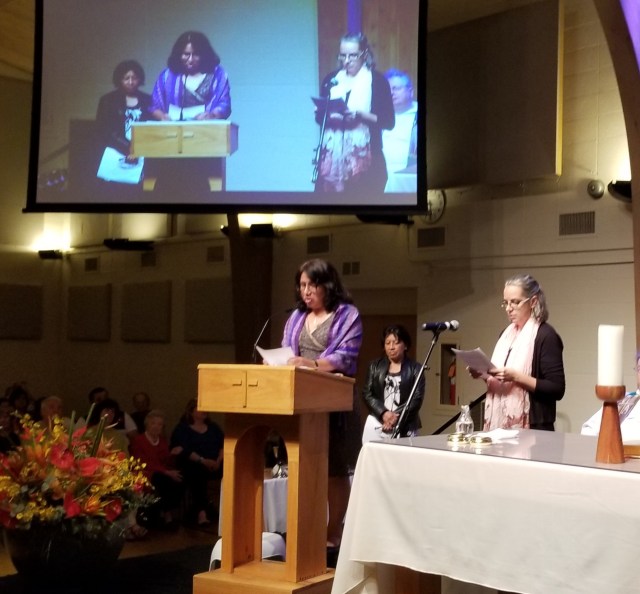
The following was shared during mass at St Joan of Arc church in Minneapolis, MN on the last day of the South to North delegation visiting from Tierra Nueva 2, Guatemala. Read the St Joan of Arc blog for a day-by-day account.

Español

Retreat participants at the end of the delegation.

Rita Nohner:
Good morning.

My name is Rita Nohner and I am a long time parishioner at St. Joan of Arc. Since my husband Jeff and I first traveled on delegation to Guatemala in 2006, we have been actively involved in this very powerful ministry, which is grounded in solidarity.

This solidarity fosters mutual understanding and a commitment to peace and justice among people in the United States and Central America. Delegation travel to the North and South with home stays is an essential aspect in enhancing awareness and understanding, and nurturing closer relationships.

This week we have been experiencing a South to North delegation with the women you see before you. Miriam and Alba, our delegates, will share with us their experiences from this past week, and Carrie Stengel, our amazing Sister Parish director, who lives and works in Guatemala, will translate for them.

We are sure their story will inspire and move you.

Alba Rivera:
This year, we celebrate the 25th anniversary of the relationship between St Joan of Arc and Tierra Nueva 2 in Guatemala.

When the first delegation from St Joan of Arc arrived, they visited us in our homes. We had never had this experience, having someone who was not family visit us. Our friendship grew, we talked about what we could do together and we fell in love. We even made engagement rings.

We remember when we came here; we saw how the women of St Joan of Arc were active leaders in the church. We saw how they spoke in public and they inspired us. I remember Auri telling me: “We need to learn how to do that.” At one point, Mindy from St Joan of Arc volunteered as our audience to prepare for a presentation. Over time, our relationship deepened, and we started the women’s project to train women in our community. Women who used to be depressed, some who did not often leave their home, they now come to the women’s group. Those who received the workshops years ago are now the leaders of the group. Now we see the women of our community serving in the church and speaking in public like I am today.

Delegates speak about their experiences during mass.

This relationship has helped us grow in our faith. We have prayer partners and our shared Bible study. We are comforted to know that you pray for us and that we pray for you, we are connected through prayer and the presence of Jesus in our lives. This week when we went to Mass in the morning, it was so intimate. We felt very close to God and all of you. We did not understand everything that Father Jim said, but the mass was like having a very good cup of coffee, or eating a plate of tortillas with beans and cream: it is not much (mass was not very long), but it is delicious and just what we needed.

This week we saw how people here care about what is happening in the world. People raise their voices for all of us at the peace march on the Lake Street bridge. We met with the Welcome the Stranger ministry and we served with the Mobile Loaves food truck. We heard more stories about what is happening on the US-Mexico border. We want to raise awareness with our youth about migration and we want to give bread to the hungry in our community too. Now we have more tools and ideas. Our experiences here give us strength to continue working even harder in our community.

Miriam Vasquez
I want to share that on this trip, the most powerful experiences have been our moments of sharing prayer and sharing our lives. Together with us, you enter into our pain and our joy. Alba’s husband, Juan Carlos, died 3 months ago and here we have cried together. When someone dies in our community, you feel the same pain, and we feel the same when someone here passes away. We fondly remember Father George Wertin, Bob Heberle and Efrain Juarez and the others who are no longer with us.

With our host families, we felt such a warm welcome. They wanted to give us their very best. In families there are always difficulties, but we could see how much love they have for each other and we felt their love. We didn’t feel like strangers, but like people who had met before, known each other for a long time. We didn’t feel like we were far away from our families.
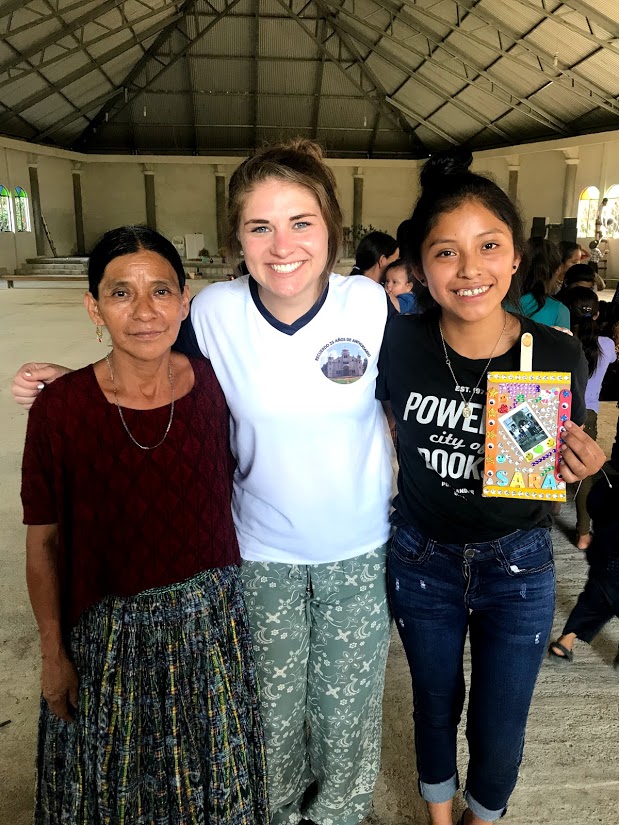
Miriam with hosts, Valerie and Daymond.

Miriam and Alba with host, Jeff.

Our relationship fits like a ring on a finger. We have adapted to our weaknesses and vulnerabilities, with a lot of respect. As in all relationships, there are disagreements, but we have always known how to handle them. This is how our relationship has lasted 25 years. St Joan of Arc never said, “They are poor, we will just do what we want”. Instead, you taught us that we can make our own decisions and that we have the right to do so as human beings. The relationship is not about serving us. It is not that one of us is better than the other. We complement each other. What one lacks, the other will give with all our love, like a marriage.

We believe this is what God wants from each of his children. God wants us to love each other and to let this love bring us closer to God. God gives each of us a nudge towards action. We may not always do it immediately, but he nudges us again so that we go back to living as God wants. God wants us to change the world we live in now, a world with so much impunity, violence and poverty. You do your part here and we do our part in Guatemala. The hope for a more just world is inside each of us. Through our relationship we realize that we are not poor. We are not alone. We are one. We are all part of one whole.

Thank you for these 25 years of sharing.

Four people were denied visas to participate in the delegation. They were present in other ways throughout the week.

Delegates serve food with St Joan of Arcs Mobile Loaves ministry.

Closing retreat at the end of the delegation.

Fun and games are also part of any good delegation experience.

“End violence on indigenous women” – Mural in Minneapolis.

We are all part of one whole.


Posted in Anniversaries, Delegations, Guatemala, South to North, United States | Tagged , , , , | 1 Comment