Movement for racial justice

“This is an emergency. I’m not talking about the coronavirus. I’m talking about racism. As all the universities in the world scramble to try to find a cure for the coronavirus – that same level of concern and action is needed to rid our society of the virus that is racism. I am calling for a declaration of a state of emergency for Black people. Racism is a public health crisis.”

–Andrea Jenkins, city council member in Minneapolis, 2020

“I will not tire of declaring that if we really want an effective end to violence we must remove the violence that lies at the root of all violence: structural violence, social injustice, exclusion of citizens from the management of the country, repression. All this is what constitutes the primal cause, from which the rest flows naturally.”

— Saint Oscar Romero, Salvadoran martyr and saint, 1979

In the wake of the George Floyd’s murder in Minneapolis and the widespread calls for systemic change in the U.S., Sister Parish joins the call that Black Lives Matter and supports the efforts led by Black people, Indigenous people and all People of Color to end systems of racism and inequality in the U.S.  We recognize that the calls are not new and did not start with George Floyd’s death but started with the unjust systems deeply rooted in our country, systems now exacerbated by the pandemic.  We call for justice for George Floyd, Breonna Taylor, Ahmaud Arbery, Tony McDade, Rayshad Brooks, Elijah McClain, Philando Castile, Jamar Clark, Michael Brown, Trayvon Martin, Tamir Rice, Sandra Bland, Eric Garner, and too many others killed by systemic and structural violence. We acknowledge the deep pain and grief that communities throughout the U.S. are feeling right now.

We believe that all people deserve to live with dignity and basic human rights. We also believe that true solidarity means recognizing and actively working to challenge and change unjust systems in partnership with the most impacted people.  The systems of racism and inequality are an integral part of U.S. history and the current reality, but they are also global systems, spread through colonialism and imperialism.  Calls for justice in Guatemala, in El Salvador, in the U.S., and throughout the world are intertwined.

As the Sister Parish community, what can we do?  We can listen, educate ourselves, and take action individually and collectively.  We can build new long-lasting relationships to promote racial justice and transform systems that oppress people. Our sistering relationships have always underlined the importance of listening, learning, and making commitments to change ourselves and our communities.  We believe that this work and each person’s journey exist on a continuum.  We are works in progress – always – and there are no simple solutions to such deeply rooted, painful injustices.  But we need to keep taking steps to uproot racism and anti-blackness in our communities and in our own hearts.  We invite our Sister Parish communities to join us in conversations, wherever people are on this journey.

What does our vision for our better world look like? What do we need to do to move our world toward one of compassion, justice, and equality in the midst of such deep crises?   In the words of Sister Parish member Miriam Vásquez, “This is hard, but we are called as Christians…to listen to the cries for help and take action. We want people alive and active in these times of violence and the pandemic.”

Thank you for being part of our Sister Parish family.  May we challenge ourselves to take more and bigger steps to dismantle racism as part of our long walk in solidarity with each other.

Sister Parish staff and board

A few resources

The following resources are only a small portion of what is available. If you are interested in sharing your local resources and actions, please let us know and we can add them.

Denominational racial justice resources

News, training and materials from organizations that work for racial justice

En español

Posted in Education and Advocacy, News, United States | Tagged | Leave a comment

Tierra Nueva 2 – Second round of food aid

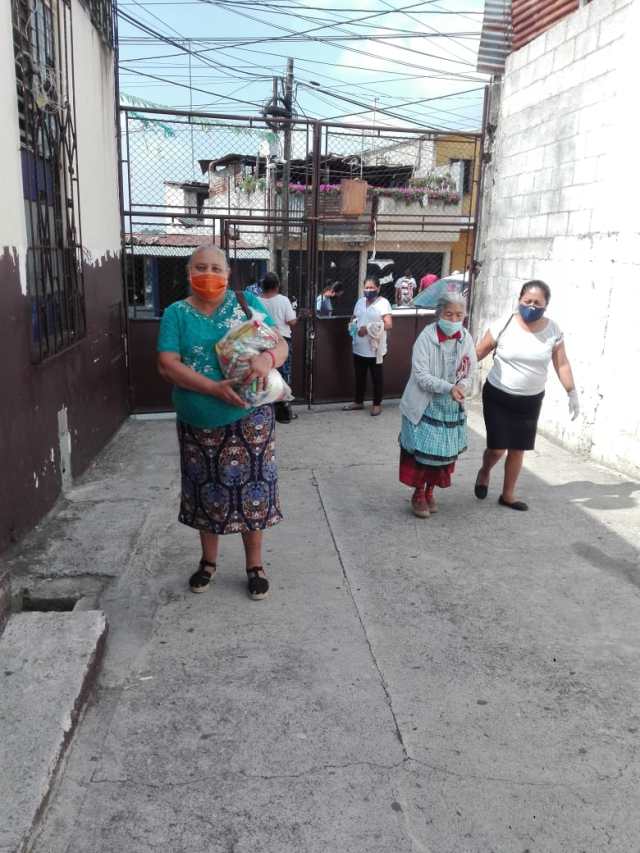
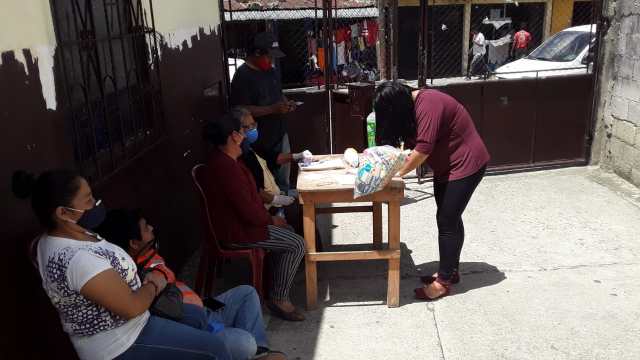
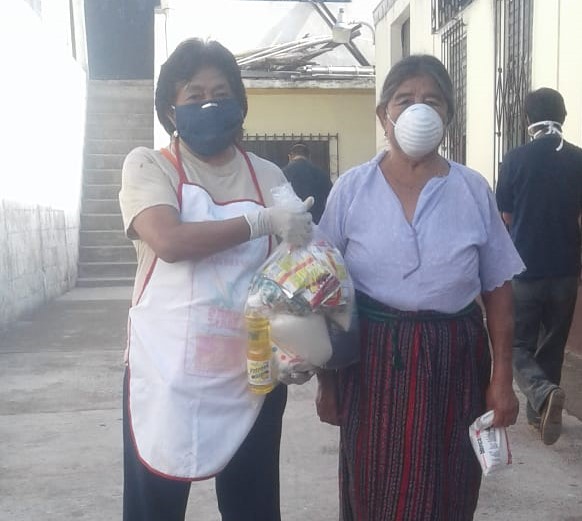
In June, the Sister Parish committee in Tierra Nueva 2, Guatemala organized a second round of food aid.  For the first round, they focused on providing food baskets and basic hygiene supplies to elders and single mothers, those thought to be among the most vulnerable to the negative economic impact of the shelter-at-home orders.  For the second round, the committee handed out food aid and basic supplies to people who had been quarantined after positive COVID-19 cases were found at the garment factories (maquilas) where they worked.  At that time, the Ministry of Health in Guatemala was supervising quarantine for families who had known exposure to the virus.  Families could not leave their homes for two weeks and relied on neighbors for food and basic necessities. Most of the workers were suspended without pay for this period.  The committee also included a few more at-risk members of the church in the second round of food aid.

Thank you TN2 for your example of solidarity in times of crisis.


Posted in Ayuda humanitaria 2020, Emergency Aid 2020, Guatemala | Tagged , , , , | Leave a comment

Moving to virtual hugs – Hacia los abrazos virtuales

Español abajo

Like most organizations in the pandemic, Sister Parish is transitioning to more and more online connections.  Whether it is Zoom, Facebook Messenger, WhatsApp, videos, photo campaigns, or our own unique combinations, we are committed to connecting our communities in our faith, in our lives and in our calls for justice.

Contact us to coordinate online activities with your partner community.  Below are just some of the ways that sister communities are connecting in the time of social distancing:

  • Bible study
  • Photo solidarity campaign
  • Committee meetings
  • Special festivals, for patron saints or anniversaries
  • Virtual delegation
  • Any other wonderful ideas you have for connecting despite distance

—-

Como la mayoría de las organizaciones en los tiempos de la pandemia, Sister Parish está haciendo la transición hacia más y más conexiones en línea. Ya sea a través de Zoom, Facebook Messenger, WhatsApp, videos, campañas fotográficas ,o nuestras propias combinaciones únicas, estamos comprometidos a conectar a nuestras comunidades en nuestra fe, en nuestras vidas y en nuestros llamados a la justicia.

Contacte con nosotros para coordinar actividades en línea con su hermanamiento.  Abajo se encuentran algunas ideas que los hermanamientos están usando para mantener viva la comunicación a pesar del distanciamiento social:

  • Estudio bíblico
  • Campaña de fotos en solidaridad
  • Reuniones del comité
  • Participación en festivales, como fiestas patronales u otras fechas conmemorativas
  • Delegación virtual
  • Cualquier otra idea que tengan para conectarnos a pesar de la distancia

Reunion call with Wallingford UMC and Guarjila. / Reunión con Seattle y Guarjila.

Danville CC participates in San Antonio’s patron saint festival. / La iglesia de Danville participa en la fiesta patronal de San Antonio.

Bible Study with St Joan of Arc and TN2. / Estudio Biblico con Santa Juana y Tierra Nueva 2.

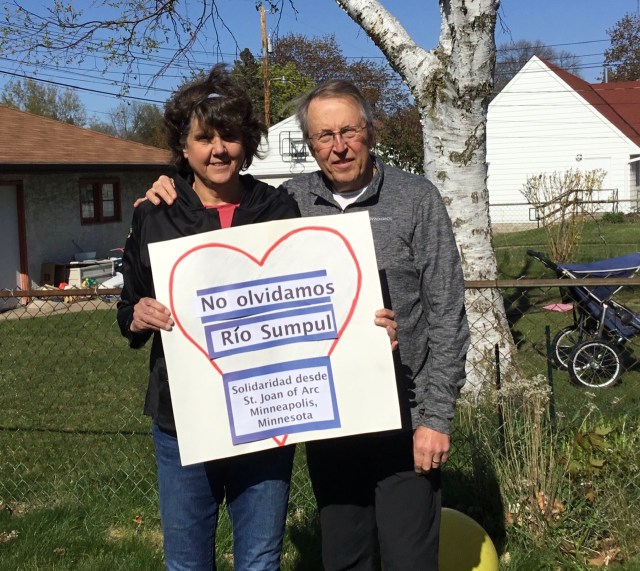
Solidarity photo campaign for the anniversary of the Sumpul River massacre. / Campaña de solidaridad para el aniversario de la masacre del Río Sumpul.

Solidarity photo campaign for the anniversary of the Sumpul River massacre. / Campaña de solidaridad para el aniversario de la masacre del Río Sumpul.

Solidarity photo campaign for the anniversary of the Sumpul River massacre. / Campaña de solidaridad para el aniversario de la masacre del Río Sumpul.

Posted in Español, General | Tagged | Leave a comment

Sister Parish May Video Update

The following video includes an update as of May 2020 on the pandemic in Sister Parish communities in Guatemala and El Salvador and community-based relief efforts to support the people most negatively impacted.

Sign up for our e-news to receive future video updates from Sister Parish staff and community members.


Posted in Emergency Aid 2020, General | Tagged , | Leave a comment

Zoom Conversation with Miriam – June 20

On June 20, Miriam Vásquez spoke with us over Zoom about the pandemic in urban areas in Guatemala and how people are drawing on their faith in a time of hardship.

Sign up for our e-news to receive notice about future Zoom conversations with Sister Parish leaders.

Posted in General | Leave a comment

How are the students? Persevering in Tierra Nueva 2, Guatemala

A conversation with Brandon Ramirez
Coordinator of the scholarship students in Tierra Nueva 2, Guatemala

I am in my last year of high school.  It has been very hard during the pandemic.  At the beginning, the teachers were preparing printed packets of our homework for us to pick-up and complete at home.  Now, the teachers are sending the homework online and we need to use Word and Excel.  I don’t have a computer, my phone doesn’t have enough memory for programs, and I don’t feel it is safe to go to the internet café because of the new coronavirus.  The market here was recently closed due to 7 vendors testing positive, so we know the virus is here.  Sometimes my friends at school send me the homework in a different format so I can print it out and do it by hand. Sometimes my sister lets me work on her phone, but it takes a long, long time to load.  Even when I can do the homework, without an explanation from the teacher, I don’t feel like I am really learning.  Many of us in my class feel like it might be better to repeat our grade next year, so that we actually learn the material.  I am not sure whether or not that will be possible for me.

Brandon (second from right) and his sister take a photo with delegates from St Joan of Arc during a tortilla-making session in TN2.

I am the Coordinator of the Scholarship Student Group here in Tierra Nueva 2 (Guatemala).  We had wanted to do more with the scholarship group this year. We wanted to have regular meetings to get to know each other and support each other more.  I was going to ask former scholarship students to join us to help us on homework or with other student difficulties.  With the pandemic, we can’t do this.  Hopefully we can try again next year.

We are still receiving the scholarship payments this year.  Our expenses are higher now, with internet use, and earning money is harder now for our families, so the support is needed. I have been checking in with the other students to see how they are doing.  Some of them are at different schools.  Some say that they have a weekly meeting by Messenger or Zoom with their teacher, who explains the material, and then assigns the homework for the week. That seems to be working better.

Even with all of the difficulties, we have seen a few positive things come out of the pandemic.  As a family, we are spending more time together and we can feel the love and the closeness of our family.  That keeps us keeping on in spite of all the negative things.  We might see that the pandemic came and destroyed everything.  But we also have more time as a family and we have time to meditate, think, and talk with God.  There are people here who forgot about God, but they are finding God again now, praying that all this passes.  We have time now for reconciliation, for meditation, and for prayer.

Brandon and other faith leaders prepare to hand out food aid to families impacted by the health measures to slow COVID-19.

Posted in Guatemala | Tagged , , | 1 Comment

Life of a student in rural Guatemala – Conversation with Tomas Tol Perez

The Guatemalan school year for public and most private schools begins in January and ends in October. This year’s fight against COVID-19 has disrupted the school year for many students in Guatemala. Teachers were preparing to enter the second trimester and grade exams. How many teachers are out of work and unable to interact with their children. Children are now missing necessary instruction to improve critical math and reading skills. This is especially evident in the rural parts of Guatemala. In Chontala, El Quiche, we spoke with Tomas Tol Perez to gain insight into how students are managing their studies during these challenging times. His daughter is among one of those students striving to finish middle school while engaging in distance learning.

COVID19 has demonstrated to many people that accessing the internet continues to be a barrier for those with scarce resources. Kids in rural Guatemala are seeing this more than any sector in the country. Specifically, in Chontala kids in primary school are no longer receiving any kind of instruction. This is due to many factors, some that are simple, other factors are more complex. Lack of access to the internet, the cost of internet access, lack of technology fluent family members are among the factors. However, it also does not help when you have a school system that never implemented technology in its everyday instruction to begin with. So, most primary school populations are completely and indefinitely without any kind of instruction.

In contrast, secondary and older school age youth are receiving some type of instruction. The amount and complexity of that instruction differs according to how available resources are in the corresponding community. In Chontala, the older youth are receiving homework, turning in assignments, and receiving occasional instructional videos from their teachers via the application WhatsApp. These exchanges between teachers and students happen around 2 to 3 times a week. These older students are considered fortunate because their futures are considered less hazy.

In Chontala and other communities, parents, students, and teachers are very worried. Many of these concerns overlap. In Guatemala, some teachers are paid by the local parents and not the government. These teachers usually teach subjects such as English. In Chontala, the English teacher is without a salary because parents can’t afford to pay for a teacher who is not able to teach their children because of COVID-19. Other teachers that are paid by the government are receiving their salaries. Parents, whose children are in primary schools are worried about whether or not their children will pass their current grade. Will there be midterms or final exams? If so, how can you test a child who has not been receiving any type of instruction? Will they be graduated automatically or forced to repeat a grade? If Guatemala finishes our shelter in place period before the school year ends, will parents be able to pay certain teachers? If they are not, who will or will students have a shortage of teachers?

Many of these questions concern an uncertain future and a future that the government is ill equipped to handle. Life in Guatemala for most has always been a balancing act of falling into an abyss or staying afloat to survive. For many, that is even more the case in these times.

Posted in Guatemala, News | Tagged , , , | Leave a comment

Communities organize in absence of government aid

Community leaders in San Andrés Itzapa organize to support families that are struggling economically due to the public health measures.

Waiting for government aid

The Guatemalan government has borrowed billions of dollars from the International Monetary Bank, Inter-American Development Bank, and The World Bank to fund various natural disaster relief programs and other programs. These programs aim to support the Guatemalan populations who are struggling financially and health wise due to restrictions on mobility and commerce in response to the global pandemic. The government has designated around Q11 billion (quetzales) to fund three programs: The Employment Protection Fund, The Capital Credit Fund, and The Family Bonus. Some features of this program include providing some families with Q1,000 a month, easing some credit payment charges, making loans more readily available, providing funding for pension plans, and protecting employment of certain employees. However, these programs have not been executed with transparency and many people have not seen the benefits.  The programs also leave certain vulnerable populations completely out of the picture.  Families can access one of the programs, for instance, by showing a low level of electricity usage on their bill, leaving families without electricity without access. Rural communities continue to wait for agricultural products promised by the Ministry of Agriculture, Livestock and Food.

No-touch thermometers were donated to the clinics in Tierra Nueva 1 and Tierra Nueva 2 through the partnership between St Joan of Arc and Tierra Nueva 2.

Communities organize locally

In the absence of government aid, many Guatemalans are taking up the torch and supporting their neighbors without help from the federal government. Doctors are buying much of their own equipment, churches and community members are gathering and distributing food supplies, non-profit and private organizations are donating much-needed financial and material support to help in efforts. Sister Parish Inc.’s community leaders are also doing their role in providing food baskets with basic grains and other food to help families through these tough times. So far, Tierra Nueva 2, Tierra Nueva 1, Chontala, San Andrés Itzapa and Chichipate have organized efforts to help their neighbors.

Leaders in Chontala organize food baskets for families in need.

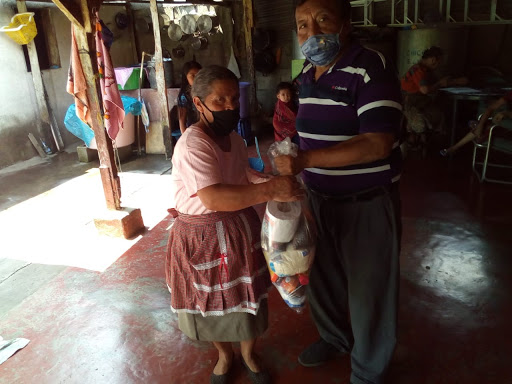
Leaders in Tierra Nueva 2 organize a food drive for elders and single mothers.

Food drive in San Andrés Itzapa.

Posted in Ayuda humanitaria 2020, Emergency Aid 2020, General, Guatemala, News | Tagged , , , , , , , , | Leave a comment

Tropical Storms hit El Salvador

El Salvador will not give up

By: Julieta Borja
Thursday, June 4, 2020

*Updates on Sister Parish communities below.

For the last three months, we have faced many difficulties in El Salvador.  We were first challenged by the COVID-19 pandemic that pushed our government to order a strict quarantine that has been extended again and again as COVID-19 cases increase.  We have now been observing strict quarantine measures for 3 months. We comply with social distancing and sanitation measures as much as possible.

The rainy season started in May in this difficult context.  Now on top of the pandemic that has only exacerbated preexisting inequalities in the country, we are also facing natural disasters. While the three powers of the state of El Salvador fight to dispute power, people all over the country are facing one of the worst crises in history.

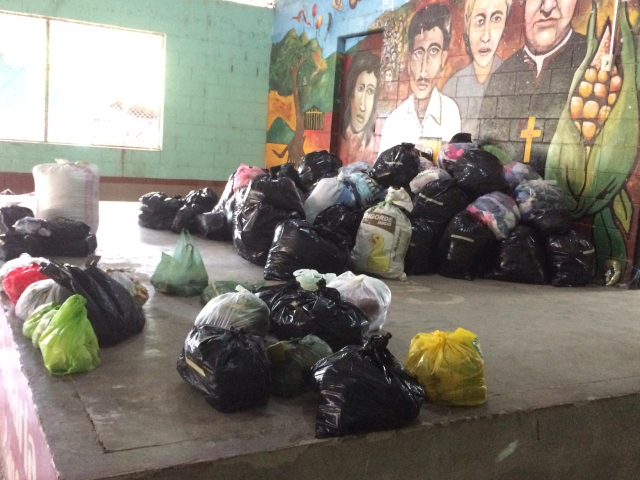
Guarjila collects supplies and food for families affected by the storm.

The weekend of May 30-31, Tropical Storm Amanda caused extensive flooding, landslides, and damage to infrastructure in El Salvador, killing at least 27 people and leaving 10 missing. Entire families died when they were pulled into the rapidly rising river. Many other families were displaced from their communities due to the high risk of flooding and landslides.  In the middle pandemic, resettling people and placing them in shelters carries additional health risks.

As of today, we are expecting more damages to come with Tropical Storm Cristobal, now threatening our people. El Salvador’s territory is so small – the whole country is in chaos right now.  The health system is doing everything possible to save people’s lives, even when sometimes emergency rooms are not enough.

The government and local authorities are not responding adequately to address the emergency.  Instead, some are taking advantage of the situation and the suffering of the people. Some politicians are going to affected areas to hand out bags of food and take pictures to post on social media.  But the population sees this more as a publicity stunt.

The Salvadoran people know we can overcome these disasters, as we have overcome other crises in the past.  People are not waiting for government aid. They organized themselves in the communities to support those in need, an example of love and solidarity to the world, once again.  Our dear Sister Parish committees in Chalatenango and La Libertad have done just that. Community members and committees have gathered food, clothing, hygiene supplies, medicine to distribute with their own vehicles.

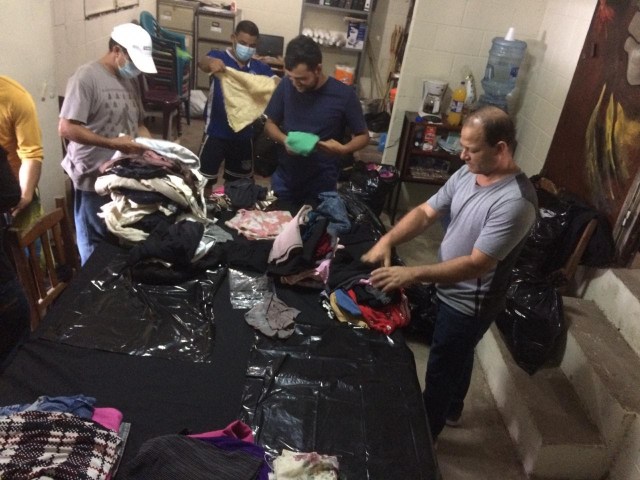
Guarjila sorts through clothing donations for affected families.

No storms, no pandemic, no broken government will stop us.  Nothing will break the Salvadoran people’s hearts. We will overcome this by  helping each other and  sharing what little we have with our brothers and sisters that need it now.

Do you want to join us and help? Please do, we will be very thankful forever.

You can donate to our emergency aid fundraiser that will support Sister Parish communities in El Salvador and Guatemala affected by the coronavirus pandemic. The aid projects will be decided by the communities in Central America, depending on their needs.

El Salvador will not give up!

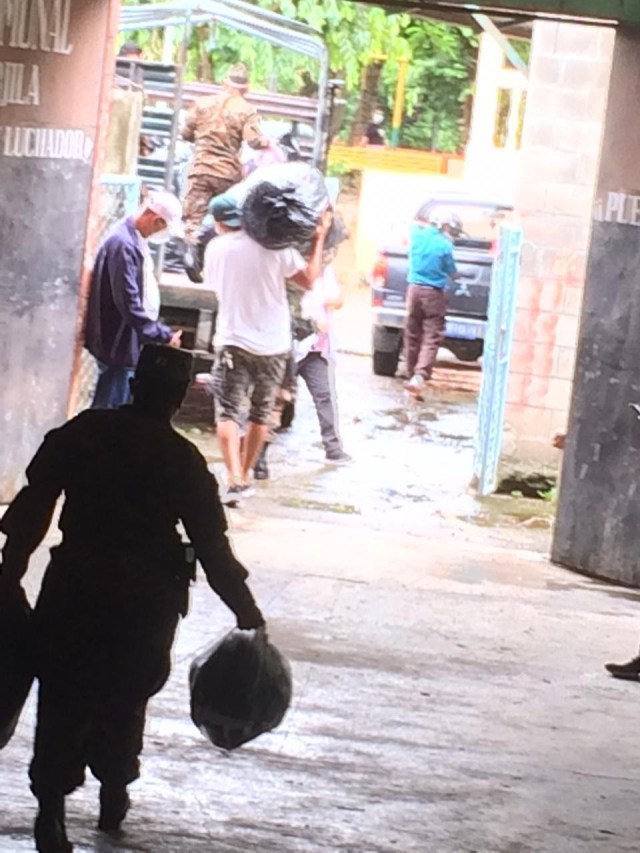
Distributing aid in Guarjila.

Updates from Sister Parish communities

San José la Montaña – People in the community are doing okay. No families were hurt in the storms and there were no damages to houses or infrastructure in the community. The tropical storms did cause landslides on the road from Las Vueltas to San Jose La Montaña. This left the community without access to the town or communication for a couple of days. People continue to observe the recommended sanitation measures and quarantine to slow the spread of COVID-19.

Guarjila – On May 26 there was a very strong storm, even before Tropical Storm Amanda, that affected Chalatenango. The storm damaged houses, community buildings, and forested areas of Guarjila.  Many trees fell down due to the strong wind and some trees fell on top of houses. Tropical Storms Amanda and Cristobal did not cause major damages in the area, but some houses started leaking. No one was hurt, thanks to God. The Guarjila Sister Parish Committee and community board (Directiva) have organized to bring food and necessary clothing and supplies to people that have been affected by the storms. They also continue observing the sanitation measures and quarantine to slow the spread of COVID-19.

San Antonio Los Ranchos – There has not been major damage to infrastructure in the community due to the storms, but some crops were damaged/lost because the soil is too damp. The community continues to  observe quarantine the best they can, also maintaining the sanitation measures recommended nationally and locally by the mayor’s office.

Potrerillos – The Río Lempa flooded some of the lower roads in Potrerillos’ municipality, Nombre de Jesús.  So far, no one has been hurt and there has been no other infrastructure damage reported in Potrerillos. They are working with the mayor’s office in Nombre de Jesús to coordinate all of the public health measures to protect the community from COVID-19.  So far, there are no reported COVID-19 cases in the immediate area.  People continue to observe the quarantine. Some people are stressed about it, but they know that this is necessary for their own health.

ACOMUJERZA in Zaragoza – The tropical storms caused numerous landslides in Zaragoza.  Both the main highway that connects the city with the capital and the highway that connects the city with the port La Libertad were shut down due to the landslides, leaving Zaragoza without access to transportation for a few days.  A nearby river overflowed, washing away houses in different communities. There have been two deaths, one caused by the mudslide and the other by the flooding of the Chilama River. There are two people still missing. Emergency shelters have been set up for the families who lost their houses or live in high-risk areas close to the riverbank. The storms have subsided for now, so the community is organizing to bring support and relief to the affected families.

As part of an urban community, the story is different here in terms of  how people are experiencing the quarantine. ACOMUJERZA  members are doing well. The cooperative has been closed since February, but employees were working two days a week to keep the business going. In mid-April, the cooperative stopped all operations to observe a more strict quarantine after the first 4 cases of COVID-19  were announced in Zaragoza. Currently there are 7 people diagnosed with COVID-19 in Zaragoza and 1 person has passed away as a result of COVID-19.

More information on Tropical Storm Amanda

From Cristosal, as of June 5, 2020 – https://www.cristosal.org/

The toll in El Salvador from Tropical Storms Amanda and Cristóbal includes

  • at least 27 dead, 10 missing
  • roughly 30,000 families affected
  • flooded/broken roads, landslides, floods, destroyed/damaged homes
  • 154 mudslides from Amanda alone, 83 of which were severe and caused complete obstruction in those areas
  • 50 pumping stations for potable water were damaged in the first (worst) day of the storm, 15 of those located in San Salvador
Posted in General | Leave a comment

Life under quarantine in El Salvador

The President of El Salvador declared a nation-wide emergency due to the pandemic.  The population is under mandatory quarantine.  People can leave their homes for basic needs twice a week according to the last numbers of their ID.  Events, church services, meetings, and non-emergency doctor’s visits are all cancelled.  Only citizens and residents are allowed to enter the country (and they were only allowed entrance as of May 1).

Unemployment and underemployment have soared. Conditions are particularly difficult for people that relied on the informal market and daily income to provide for their families.  The central government has approved a number of economic relief efforts, such as a $300 bonus for eligible families.  One of the factors that determined eligibility was a low use of electricity.  Unfortunately, this leave out families that do not have electricity and are, arguably, some of the most in-need.

Deportations from the U.S. have continued the whole time, even when all other international entry was prohibited.  Approximately 1,500 people were deported between mid-March and mid-April alone.

The government has been criticized for the treatment of prisoners and denounced for the abuse of authority in the enforcement of public health measures.

In spite of all of the difficulties, there are beautiful examples of solidarity in this time of crisis.  Some people are organizing for the collective well-being of their communities in inspiring ways.

What does life look like for the Sister Parish communities in El Salvador? Below members from each community tell us more.

Distributing food to families in Guarjila.

Guarjila 

Carlos – We think Guarjila is complying with the public health measures about 90% for the days we have been in quarantine – what is it now? 40 days? 50 days? 90 days? Haha. We have looked for ways to support families that don’t have food.  Our movements are not so restricted right now.  We can go to Chalatenango 2 times a week.  There is a checkpoint on the road that has been set up coordinating with the municipalities and community leaders in the area.  There are no cases yet in Guarjila and we believe we are stronger than a virus.

Marleny – The community board (Directiva) has worked closely with the soldiers and police to carry out the measures currently in place.  The health clinic is also working hard. They are doing home visits, house by house in the entire community, to talk about the measures and why they are important.  It is sad to see the streets so empty when we go out.  The majority of the families here received the $300 (part of the relief package offered by the federal government), but the mayor did not give Guarjila anything (the mayor of Chalatenango did hand out food baskets in other communities). The Directiva asked the mayor to provide some aid, but the mayor said no.  The food aid we have been able to hand out to almost the whole community was made possible by families in the U.S. that came together and sent money to help Guarjila.  They told us they have more possibilities, but we actually see that they might be worse off than us. They have to pay rent and bills – we don’t pay rent or bills. They have to pay for all of their food – here many people have corn and beans from their harvest.  The first food baskets were $15/basket, later a little less at $11/basket to be able to cover more families.

Holy Week – With services canceled, people in Guarjila celebrated Holy Week by listening on the radio or watching on TV.  On Good Friday, the priest went through the town by house to offer blessings for those who wanted them.  The Faribundo radio station is broadcasting a daily mass in the afternoon.

Gurajila farmers are starting to prepare their fields for planting now that the rainy season has started.  The farmers are hoping to increase production given the projected increase in the demand for food in the region.  Guarjila is looking at whether or not they might be able to use the school as a center to store and distribute seeds, fertilizer, and other agricultural products for farmers.
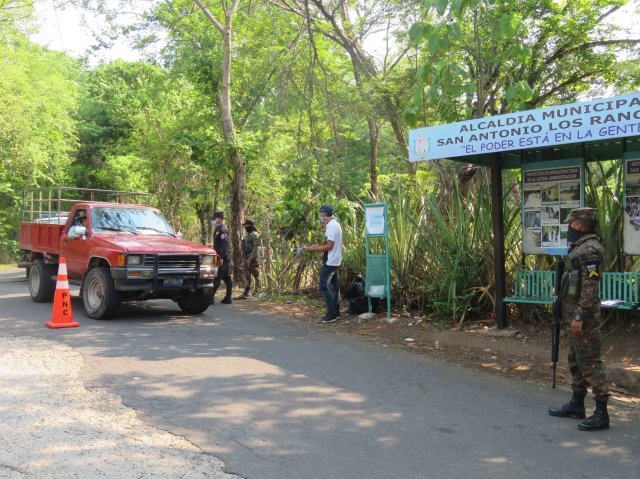
Checkpoint for disinfection and health checks in Los Ranchos. Photo: Mayor’s office of San Antonio Los Ranchos.

Los Ranchos

Consuelo – Most people are following the recommendations.  People go out but just to buy food or what they most need. The police are on call. The municipality gave food baskets and masks to every family in Los Ranchos.  The municipality also already has a program that provides elders with food baskets on a regular basis. Most people are using the masks. There was a checkpoint at the entrance to the town, but since there is now one in a nearby town, they removed it. The health clinic is separating patients who come in with a fever or a cough, providing care in an area in front of the clinic.  There are no cases in Los Ranchos yet. People are very worried about their family members in the U.S.  People in Los Ranchos have family members in the U.S. that have been infected and gone to the hospital and they are not treated. They were sent home.  Thankfully, no family members have passed away at this point.  We are also worried about our family members in the U.S. now that unemployment is so high. We are worried they could be evicted and there are no policies to protect renters or support migrants financially.  The church is closed – there are no masses.  The priests are anxious.  There are only 2 pupuserías open now and they only take to-go orders. Some people have received support from others in Los Ranchos too – for instance, some people, seeing a family or an elder in need, have donated their food basket or help out other ways economically.

Holy Week – Here people celebrated Holy Week by connecting to services on the radio, the TV or Facebook Live.  The priest went through the town on Good Friday so that people could receive a blessing.

Haydee – In Los Ranchos we need to look at how to support people that didn’t receive any help from the government.  (The federal government provided $300 per family to qualifying families and many local governments in the area have given out food baskets).  I have talked to some families that received nothing.  We should figure out a way to help them.

Consuelo – It is sad to see our town so empty. Who knows when we will be able to visit each other again. It is sad not to be able to be with family or friends who are grieving too – like Carlos from Guarjila whose father just passed away.  It is very hard.  I am very worried.  And at least here, we can go out to find a mango on a tree, but in the U.S. our family members are in small apartments, they have to buy their food.  My little granddaughter wants to go out.  It is very hard on the kids in the U.S. We pray to God that this will pass and that we will be able to see each other and go back to some kind of normal.
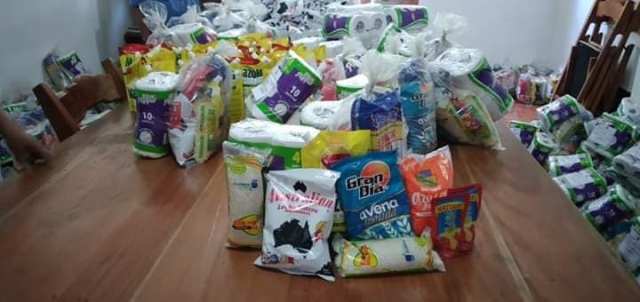
Packaging food and basic supplies to be distributed to families in Las Vueltas, the municipality where San Jose la Montaña is located. Photo: Mayor’s office of Las Vueltas.

San José la Montaña

As of  April 27, there were 6 confirmed cases of COVID-19 in the state of Chalatenango: 2 in Chalatenango, 3 in Nueva Concepcion, and 2 in San Miguel de Mercedes.

Erlinda is taking extreme measures because of her job in health care. She goes to work in the clinic in Las Vueltas every day.

Juventina is supporting the disinfection and health control stations at different points in the municipality.   They are trying to control who comes in and out of the municipality as much as they can.  Juventina is also visiting different families in the municipality and helping to distribute food baskets and explain public health measures to each family.  They talk with each household about handwashing, disinfecting, and the steps to take when coming back to the house after running errands in Chalatenango.

People in San José la Montaña are still working in agriculture.  People are starting to promote the use of green houses and family vegetable gardens.  Some people are panicking. This is very stressful.  But the quarantine experience in rural areas is very different. Surviving is more hopeful in the rural areas. People have food and resources.

In terms of public transportation, there are just two options, one at 5:30 and the other 6:40 (but the latter is not guaranteed).  The municipal government is giving bags of food to all families in the municipality. The majority of the families have received $300 from the central government as part of the national relief package.  There are about 5 families from the community who did not receive the bonus.

The CCR is working on food security and sustainability. Policies should focus on supporting people in producing their own organic, locally grown food.  The fact that the rainy season is just starting is an advantage.

CORDES and CCR are also campaigning with the women’s movement in Chalatenango to address domestic violence and violence against women.  People are concerned about the rise in domestic violence and other types of violence under quarantine.  There have been 13 femicides in the country since the beginning of the mandatory quarantine – 1 in Chalatengango.  The organizations have a wonderful campaign to support and encourage people living with violence to report it and look for help.  The campaign is important since people may have lost their usual support networks due to the quarantine and restrictions under shelter-at-home orders.
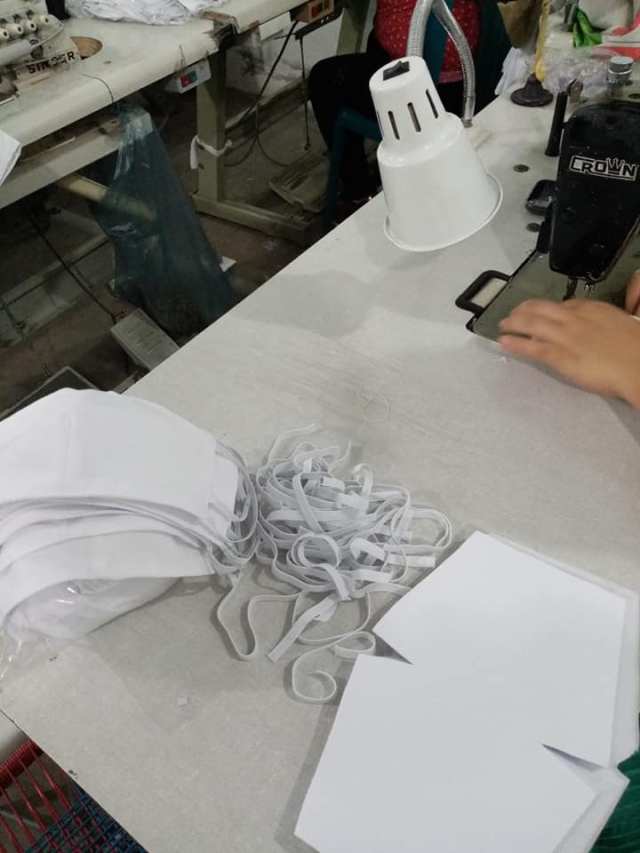
Making masks at ACOMUJERZA. Photo: ACOMUJERZA.

ACOMUJERZA

Ana and Julieta – In Zaragoza, there is now a checkpoint at the entrance to disinfect cars and people entering the town.  The municipality has handed out food baskets ($15 of food and basic supplies) to a large portion of the people in the town center.  In San Jose Villa Nueva, where Ana now lives, they have handed out anit-bacterial gel, gloves and masks, but not many food baskets in the town center. The food baskets were handed out in the outlying areas. Everyone in El Salvador is under mandatory quarantine and there is a curfew in many municipalities. There have been no cases in Zaragoza, but there have been close by.

Ana – From what I have heard, the ACOMUJERZA members and their families are doing well.  None of the members received the government stimulus of $300.  ACOMUJERZA has been closed since March 21, but we are looking at ways to start work on the uniforms again with measures. Maybe 2-3 people will go in at a time. As a business we have to keep paying our members and our bills and our taxes, but we have had no income since we closed.  So we are looking at alternatives.  We currently have an order for masks.  And we are talking about what else we could do to diversify our sales.
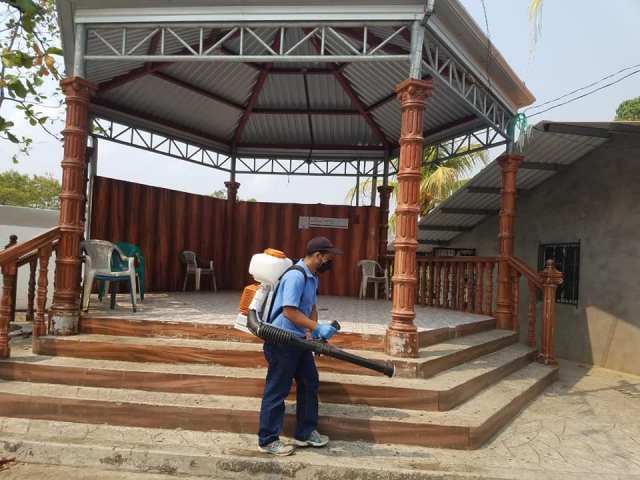
Disinfecting public spaces in Nombre de Jesus, the municipality where Potrerillos is located. Photo: Mayor’s office of Nombre de Jesus.

Potrerillos

In general people in the community are doing well.  The majority of the population is following the recommended health measures and observing the quarantine.

Farmers are already preparing their land for planting now that the rainy season is starting. The municipality is registering all families that plan to plant this year.  They want to ensure that people receive fertilizer, seeds and other agricultural products needed at this stage in the growing season.

Working with the mayor’s office, the community board (directiva) is trying to promote family gardening projects. The gardens are one response to the food crisis and general economic crisis expected as a result of the pandemic.

Access to water is still a challenge in the community, but the community board (directiva) is trying to reorganize to make sure all families have enough water in their homes. Community leaders want families to be able to carry out the recommended hygiene and sanitation measures.

Medical care is provided for emergencies only. Patients with chronic illnesses and monthly medications are still able to go to the health clinic to pick up what they need. Health promoters and nurses try to do weekly home visits to all families in the municipality to check on people’s health. The home visit medical team prioritizes the patients that have more delicate health situations.

Schools are closed across the country. Some students are receiving classes online, but the internet is not accessible to all children and youth.  Some teachers also prepare printed school work that the parents can pick up at the school, so students can work on the packet during the week. Teachers have also formed groups in the phone application WhatsApp.  They can send pictures or study guides to families and parents can print some things to work on with their children.

Two people from Potrerillos who were living in the U.S. have died of COVID 19.
Posted in El Salvador, General, News | Tagged | Leave a comment