Versión en español abajo
by Doug Fogg
A group from East Orrington Congregational Church, Maine visited our sister parish community Virginia, Guatemala for the first time in May 2023, after waiting anxiously for 3 years because our 2020 delegation was canceled due to the pandemic.
If there is one thing that was confirmed for me over and over on this trip is that, as Christians, we are called to great love and unity. And the best way to pursue greater love and unity is to put yourself into the shoes of another and learn from their reality, whether they be next door or on the other side of the world.
Accepting gracious hospitality
While in Virginia, we stayed with the family of Fernando and Julia. Fernando was a farmer but doesn’t do as much farming anymore. He is also a miller, grinding corn, mostly for his very large family, but for his neighbors. Julia is a registered midwife. She is now 75 and, in her career, has delivered over 1000 babies, including her own 15 children, over 50 grandchildren, and many of her great grandchildren. Of all those deliveries, she has only had to send one woman to the hospital for complications, which is good, because, though they do have a maternity clinic 30 minutes away, the closest hospital is 4 hours away.
On our last night in Virginia, we had a celebratory dinner and prayer service. We thanked them so much for their gracious hospitality and friendship. They thanked us for our visit and for our partnership. It meant so much to them that we stayed in their homes, ate with them, got to know their lives, and listened to what they had to say.
When we left Virginia, there were lots of hugs and lots of tears. I was especially moved when Julia embraced Danielle, not letting go, and shared her love and prayers with us. There were a lot of words and we only understood a few of them. Nonetheless, the love and honor that was conveyed was evident and very intense. Sometimes you just don’t need the words.
Exchanging recipes
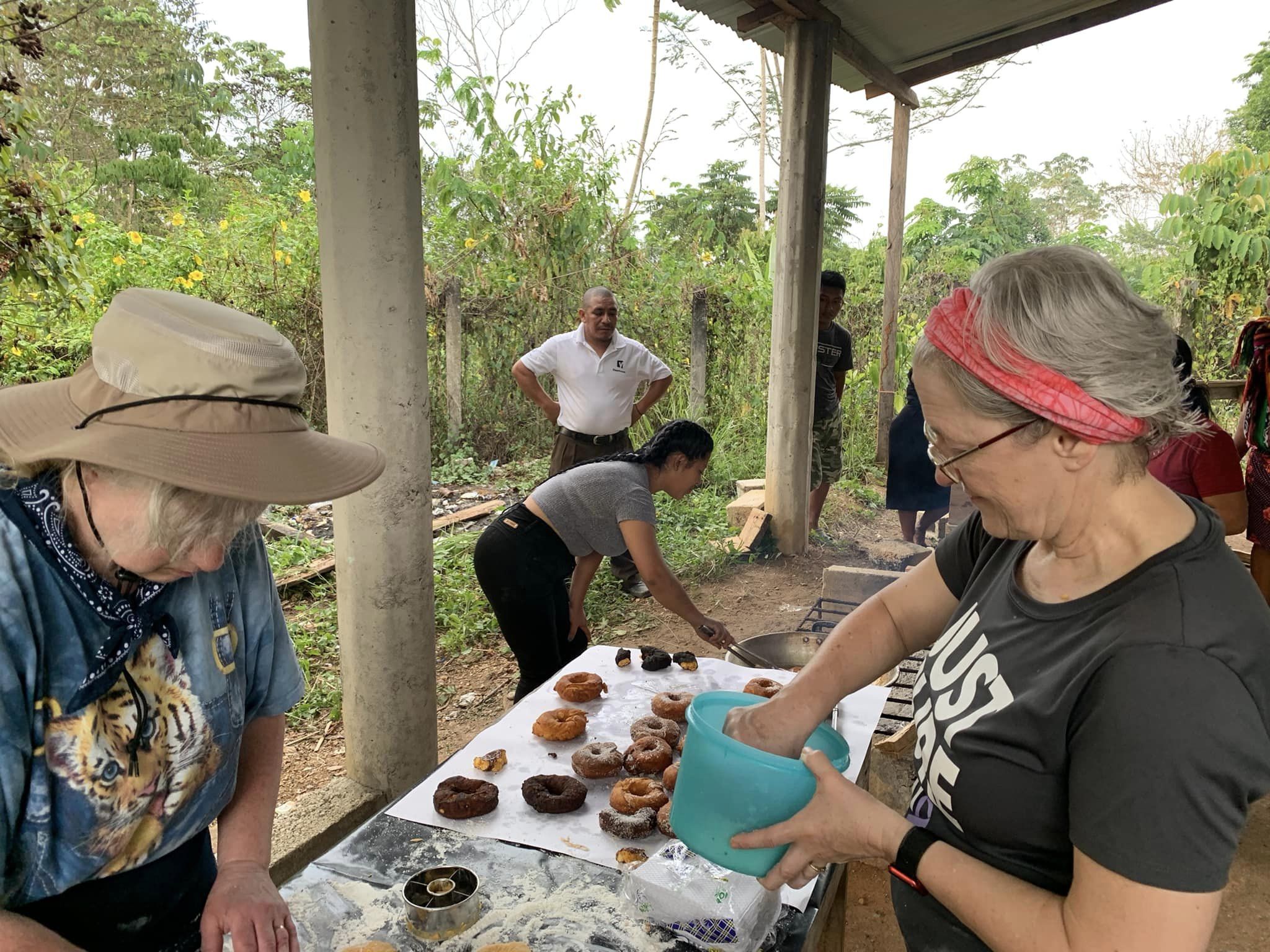
People in Virginia had heard that we raised a major part of our funds for the trip by making and selling doughnuts, so they wanted to learn how we did it. I mixed up a triple batch for 9 dozen doughnuts and started to fry. Now I’ve never deep-fried doughnuts over an open fire before, so I was no good at adjusting the heat. The first few doughnuts burned on the outside. Severiano and his wife Carolina quickly took charge of the fire and frying, and the rest of the doughnuts turned out wonderfully and were a big hit!
The next day, our new friends Pablo and Francisca returned the favor by teaching us how to make chocolate, from tree to the table, Guatemalan style!
Cocoa beans, or cacao, as it is called in Guatemala, grow in a very tasty, good-sized fruit that grows in cacao trees. It is harvested, then the beans have to be extracted, cleaned, and dried in the sun for about 3 days. It is then slow roasted on a clay disc over hot coals for 60 to 90 minutes, while the beans are stirred constantly so they don’t burn. The result is a very dark, bitter nut. They are then husked or peeled, then finely ground, along with sugar and cinnamon (which the family also grows), and mixed and kneaded very carefully, then pressed into a mold. Once this is hardened, the result can either be eaten as candy or melted in hot water (not milk) to be turned into their traditional chocolate drink.
After the beans are roasted, Francisca often roasts corn on the same disc and runs it through the same, uncleaned mill to make a chocolate-flavored corn-based drink that is also traditional to the area. Running the corn through the mill after the cocoa beans also cleans the mill blades! Absolutely fascinating…and delicious!
Laying the foundation for a partnership
While in Virginia, we met with the Sister Parish committee to talk about how we could best move our relationship forward. We discussed what had brought both Virginia and East Orrington Congregational Church to this point, the success of this delegation (all were thrilled with this delegation and the relationship that has been established so quickly), and what to do from here.
We decided we would meet over Zoom or WhatsApp and share prayer intentions. We mentioned that our annual meeting was coming up and prayers would be appreciated for that. They asked for prayers for their national elections in June and support in addressing the lack of water in the community.
We ended the meeting with prayer and thanksgiving for our new friendship, praying that God would bless our relationship for many years to come!
Returning home
Will this experience change our lives? I would say yes, without doubt. Once you put yourself in someone else’s reality, the trajectory of your life can’t help but change, and the perspectives and paradigms you once held shift and broaden.
For the rest of our lives, Danielle and I will be practicing loving people; people who are different from us, people who live different lives, people who have issues, people who don’t believe as we do, people who disagree with us, people who are hurting, people who have made mistakes….we’re going to seek out as many opportunities as we can to do this and we will use what we learn from people to change our views, broaden our perspectives, and do what we can to make the world a better place. That will happen in any place we happen to be in the whole world, including our own backyard. This is what Jesus Christ taught so that’s the way we will live. We are home.





Visitamos nuestro hermanamiento Virginia en Guatemala por primera vez en mayo de 2023, después de esperar ansiosamente durante 3 años porque nuestra delegación de 2020 fue cancelada debido a la pandemia.
Si hay algo que me confirmó una y otra vez en este viaje es que, como cristianos, estamos llamados a un gran amor y unidad. Y la mejor manera de buscar ese gran amor y unidad es ponerse en el lugar del otro y aprender de su realidad, ya sea que sea nuestro vecino o al otro lado del mundo.
Aceptar la hospitalidad amable
Mientras estuvimos en Virginia, nos quedamos con la familia de Fernando y Julia. Fernando era agricultor pero ya no se dedica tanto a la agricultura. También es molinero y muele maíz, principalmente para su numerosa familia, pero también para sus vecinos. Julia es partera registrada. Ahora tiene 75 años y, a lo largo de su carrera, ha dado a luz a más de 1000 bebés, incluidos sus 15 hijos, más de 50 nietos y muchos de sus bisnietos. De todos esos partos, sólo ha tenido que enviar a una mujer al hospital por complicaciones, lo cual es bueno, porque, aunque tienen una clínica de maternidad a 30 minutos, el hospital más cercano está a 4 horas.
En nuestra última noche en Virginia, tuvimos una cena de celebración y un servicio de oración con el Comité de Hermanamiento y algunos miembros de la comunidad. Les agradecimos mucho por su amable hospitalidad y amistad. Nos agradecieron nuestra visita y nuestra colaboración. Significó tanto para ellos que nos quedáramos en sus casas, comimos con ellos, conocimos sus vidas y escuchamos lo que tenían que decir.
Cuando dejamos Virginia, hubo muchos abrazos y muchas lágrimas. Me conmovió especialmente cuando Julia abrazó a mi esposa Danielle, sin soltarla, y compartió su amor y sus oraciones con nosotros. Había muchas palabras y sólo entendíamos algunas de ellas. Sin embargo, el amor y el honor que se transmitió fue evidente y muy intenso. A veces simplemente no necesitas las palabras.
Intercambiar recetas
La gente de Virginia había oído que recaudamos una parte importante de nuestros fondos para el viaje haciendo y vendiendo donas, por lo que querían saber cómo lo hacíamos. Mezclé un lote triple para 9 docenas de donas y comencé a freír. Ahora bien, nunca antes había frito las donas a fuego abierto, así que no logré ajustar bien el fuego. Las primeras donas se quemaron por fuera. Severiano y su esposa Carolina rápidamente se hicieron cargo del fuego y la fritura, y el resto de las donas quedaron maravillosas y ¡fueron un gran éxito!
Al día siguiente, nuestros nuevos amigos Pablo y Francisca nos devolvieron el favor enseñándonos a hacer chocolate, del árbol a la mesa, ¡al estilo guatemalteco!
Los granos de cocoa, o cacao, como se le llama en Guatemala, vienen de un fruto muy sabroso y de buen tamaño que crece en los árboles de cacao. Se cosecha, luego se extraen los granos, se limpian y se secan al sol durante unos 3 días. Luego se tuesta lentamente sobre un disco de arcilla (o comal) sobre brasas durante 60 a 90 minutos, mientras los granos se revuelven constantemente para que no se quemen. El resultado es una semilla muy oscura y amarga. Luego se descascaran o pelan, luego se muelen finamente, junto con azúcar y canela (que la familia también cultiva), se mezclan y amasan con mucho cuidado y luego se prensan en un molde. Una vez endurecido, el resultado se puede comer como caramelo o derretirse en agua caliente (no en leche) para convertirlo en su tradicional bebida de chocolate.
Después de tostar los granos, Francisca suele tostar el maíz en el mismo disco y lo pasa por el mismo molino sin limpiar para hacer una bebida a base de maíz con sabor a chocolate que también es tradicional de la zona. ¡Pasar el maíz por el molino después de los granos de cacao también limpia las aspas del molino! Absolutamente fascinante… ¡y delicioso!
Sentar las bases para el hermanamiento
Mientras estábamos en Virginia, nos reunimos con el Comité de Hermanamiento para hablar sobre cómo podríamos hacer avanzar mejor nuestra relación. Discutimos qué había llevado a Virginia y a la Iglesia Congregacional de East Orrington a este punto, el éxito de esta delegación (todos estaban encantados con esta delegación y la relación que se había establecido tan rápidamente) y qué hacer a partir de ahora.
Decidimos reunirnos por Zoom o WhatsApp y compartir intenciones de oración. Mencionamos que se acercaba nuestra reunión anual y agradeceríamos oraciones por eso. Pidieron oraciones para sus elecciones nacionales en junio y apoyo para abordar la falta de agua en la comunidad.
¡Terminamos la reunión con oración y acción de gracias por nuestra nueva amistad, orando para que Dios bendiga nuestra relación por muchos años más!
Volver a casa
¿Esta experiencia cambiará nuestras vidas? Yo diría que sí, sin duda. Una vez que te pones en la realidad de otra persona, la trayectoria de tu vida no puede evitar cambiar, y las perspectivas y paradigmas que alguna vez tuviste cambian y se amplían.
Por el resto de nuestras vidas, Danielle y yo practicaremos amar a las personas; personas que son diferentes a nosotros, personas que viven vidas diferentes, personas que tienen problemas, personas que no creen como nosotros, personas que no están de acuerdo con nosotros, personas que están sufriendo, personas que han cometido errores… vamos a buscar tantas oportunidades como podamos para hacer esto y usaremos lo que aprendamos de la gente para cambiar nuestros puntos de vista, ampliar nuestras perspectivas y hacer todo lo que podamos para hacer del mundo un lugar mejor. Eso sucederá en cualquier lugar del mundo en el que nos encontremos, incluido nuestro propio patio trasero. Esto es lo que Jesucristo nos enseñó, así es como viviremos. Estamos en casa.


 sisterparishinc
Pingback: Open Delegation 2023 / Delegación Abierta 2023 | sisterparishinc